What Carrot doesn't do

What Carrot doesn't do: every step from the lead to the paycheck, and who covers it.

Updated Carrot’s prices checked on carrot.com on

Carrot covers the first step of a real estate deal fully: it builds the website that brings you the seller. Of the eight steps after that, Carrot covers four in part (follow-up, pricing the house, signing and getting paid, with monthly limits by plan) and the learning step in part, and three are not on Carrot's pricing pages at all: estimating repairs, making the offer and selling the deal to a cash buyer.

A few words first, in case this is new. A real estate investor buys houses directly from their owners, often houses that need work. The owner finds the investor online and leaves their details: that is a lead. But nobody is paid for a lead. You are paid when the deal closes, and between the two you call the seller, price the house, estimate the repairs, make an offer, sign a contract and, if you are a wholesaler, sell that contract to a cash buyer for a fee. This page takes all nine steps in order. For each one it shows what Carrot covers, quoting Carrot's own pricing pages, what investors usually use otherwise, and what Apex Vivus covers.

Apex Vivus competes with Carrot, so we are not neutral. That is why every Carrot fact here is from carrot.com, linked and dated, why the step Carrot covers fully is marked fully, and why "not on Carrot's pages" means only that: we did not find it on Carrot's own pricing and plan pages, read on 14 November 2026. You decide what matters for your business.

Out loud, about five minutes. Ask him anything.
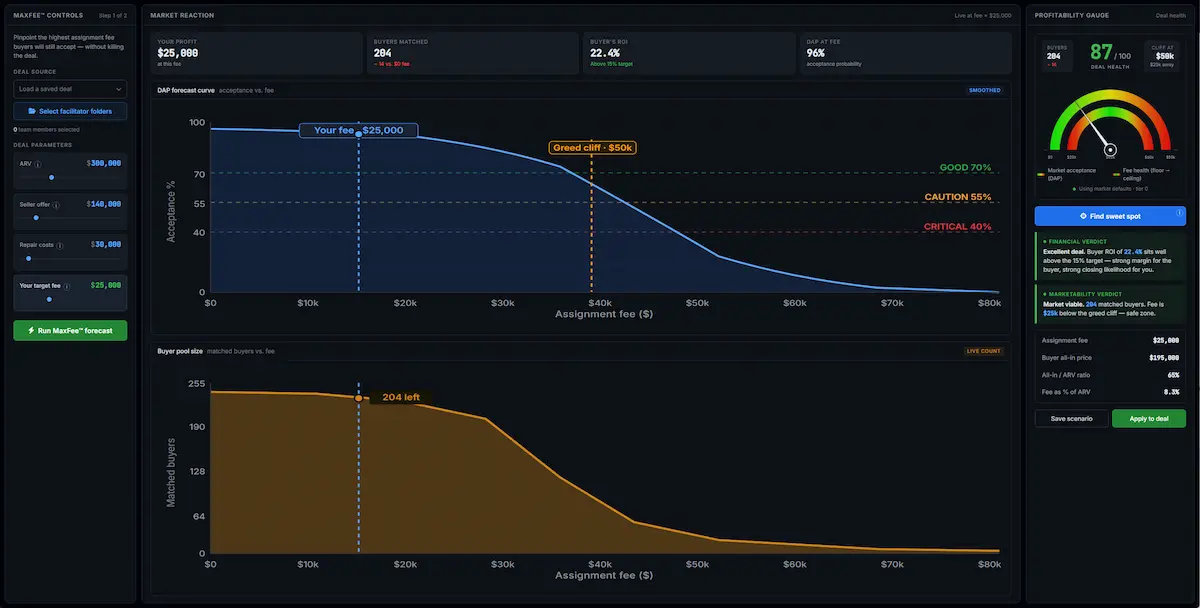
The short answer

What Carrot does, and what it leaves to you.

Carrot does the website and the lead well, and leaves most of the deal after the lead to other tools. This card is the short version of everything below, as of 14 November 2026.

What Carrot is
A company that builds websites for real estate investors and agents and gets them found on Google, with a CRM, CarrotCRM, for keeping track of leads.
What it costs
$119 a month for the website ($99 a month paid yearly), with a free CRM for one person. A team CRM is $69, $179 or $349 a month more. AI Suite $99 a month, Premium Support $69 a month.
What it covers fully
Step 1, the lead: an AI website builder, 50 location pages, SEO tools and a call tracking number.
What it leaves to you
Estimating repairs, making the offer and selling the deal to a cash buyer are not on its pricing pages. Follow-up, pricing, signing and getting paid are covered in part, with limits that rise with the plan.
What Apex Vivus covers
All nine steps, in one place: $97 a month for Core (the website, the CRM and marketing) or $147 a month for Power-Up (adds the repair, offer, fee and buyer tools).

From carrot.com/pricing and carrot.com/crm-pricing, read 14 November 2026, and Apex Vivus pricing. Every Carrot plan and limit is in our Carrot pricing guide.

The whole deal, on one line

Nine steps from the lead to the paycheck.

A deal has nine steps, and Carrot covers the first one fully. Each box below is one step; the orange bar shows how much of it Carrot's own pricing pages cover. A full bar is covered, half a bar is covered in part, and an empty bar is not on Carrot's pages.

  1. 1The lead arrivesCovered
  2. 2You follow up and callPartly
  3. 3You price the housePartly
  4. 4You estimate repairsNot on Carrot's pages
  5. 5You make the offerNot on Carrot's pages
  6. 6The seller signsPartly
  7. 7You sell the dealNot on Carrot's pages
  8. 8You get paidPartly
  9. 9The next deal starts smarterPartly

The pattern is plain. Carrot is strongest at the start, where a seller first finds you, and covers less the closer you get to the money. That is not a criticism: Carrot is a website company, and the website is the start. But it means the steps where an investor makes or loses money, the repair estimate, the offer and the fee, happen somewhere else.

Covered on Carrot's pagesCovered in partNot on Carrot's pages
Step by step, in a table

Who covers each step: Carrot, other tools, or Apex Vivus?

Carrot covers one step fully and five in part; Apex Vivus covers all nine. The middle column is what investors on Carrot usually use for that step instead, by kind of tool, because naming one company would be a recommendation we have not tested.

StepCarrotCarrot coversOtherwise, investors useApex Vivus
1. The lead arrivesCovered A website with an "AI website builder", 50 location pages, SEO tools and the free CarrotCRM to hold the leadNothing else needed for this stepA website built around you, a seller form that rewrites the page for each situation, an instant photo offer and a sale forecast
2. You follow up and callPartly Texting and email in every CRM plan; 3 follow-up sequences free, 8 or 15 on paid plans; automatic replies to new leads and inbound call pop-ups from $179 a monthA phone and texting app, a dialer, a scheduling toolOne inbox for texts, calls and email, follow-up sequences, automatic replies, missed calls texted back, and an appointments calendar, for every user
3. You price the housePartly "Property Data" reports: 5 a month free, 50, 100 or 200 a month on paid CRM plansProperty-data websites, county records, an agent friend for comparable salesA Deal Room on every lead: public records, what the owner owes and real nearby sales, on one screen
4. You estimate repairsNot on Carrot's pages Not on Carrot's pricing or plan pagesA spreadsheet, a contractor's walkthrough, a repair-estimating appEstiMate prices the repairs from your walkthrough photos, at your own rates (Power-Up)
5. You make the offerNot on Carrot's pages Not on Carrot's pricing or plan pagesA rule of thumb, an offer calculatorOfferAid works out your offer from the value, the repairs, your fee and what the cash buyers who fit the house need to earn (Power-Up)
6. The seller signsPartly "Contracts": 5, 20 or 50 e-signature sends a month on the $69, $179 and $349 CRM plansAn e-signature service, a contract template from a lawyerBuilt-in e-signatures with your own agreements, filled in from the lead, with no monthly send limit; DealDraft builds your deal team
7. You sell the dealNot on Carrot's pages Not on Carrot's pricing or plan pagesYour own buyer list, group chats, deal-listing websitesMaxFee sets your fee, Buyer Match finds the buyers, and the Repository puts the deal in front of REILink's verified cash buyers, free
8. You get paidPartly Transaction management on the $179 and $349 CRM plansA title company's updates, a spreadsheet of dealsYour pipeline follows the deal to closing; a signed agreement moves the lead to Under Contract by itself
9. The next deal starts smarterPartly Campaign tracking links, one call tracking number, reports, and AI lead scoring in the $99 AI Suite; Carrot's FAQ says it does not run Google or Facebook adsThe ad platforms' own dashboards, guessworkWhen a deal closes, your Google and Facebook ads are told which seller became a paycheck and what it made

Carrot's column quotes carrot.com/pricing and carrot.com/crm-pricing, read 14 November 2026. "Not on Carrot's pages" means we did not find it on those two pages or Carrot's plan pages; Carrot may offer something we missed, or add it later.

Each step, explained

Every step of a deal, and who covers it.

Each step below starts with what it is, in plain words, then what Carrot covers, what investors use otherwise, and what Apex Vivus covers. Where there is a real screen of the Apex Vivus tool, it is shown.

1

The lead arrives

A homeowner finds you and asks about selling

Covered

A lead is a homeowner who has raised a hand: they called, texted or filled in the form on your website because they are thinking about selling. Most investors who sell to homeowners directly get these leads from a website that shows up when someone searches for something like "sell my house fast" in their town. Getting found on Google is called SEO, short for search engine optimization: the work of making your pages the ones Google shows first.

What Carrot covers

This is the step Carrot is built for, and it covers it fully. Its $119-a-month plan includes an "AI website builder", 50 location pages (a page for each town you buy in, so you can be found there), SEO tools, one call tracking number with 100 minutes and 25 texts, and the free CarrotCRM to hold each lead. Carrot has done this for investors for more than ten years, and its customers praise its training on getting found.

What investors use otherwise

Nothing else needed for this step.

What Apex Vivus covers

Apex Vivus covers this step too. Your site is designed around you, so it does not look like every other investor's. Its seller form, SmartForm, changes the page around the answers the seller gives, so a seller facing foreclosure and a landlord tired of tenants each read about their own situation. PageForge writes a page for each town you buy in, and the blog writer drafts posts about your market. Two tools on the site give sellers a reason to leave their details: Instant Offer gives them a range for their house from photos, and Home Sale Forecast shows what selling the usual way would cost them.

An Apex Vivus investor website, the home page of a Connecticut house buyer
An Apex Vivus website Jerryll's own Connecticut site, moved from Carrot to Apex Vivus. The seller form, the offer and the forecast are on the page.

Does a website alone bring sellers? It can. Shade Forkner, who buys houses in Seattle, posted this about the first lead from his Apex Vivus website, in his own words:

Shade ForknerOctober 26, 2026 · Facebook

I got my first Lead on my Vivus website! She filled out the info box.

it's a multimillion Dollar house on the lake, looks like a low repair costs by the pics.  ARV of 15 million.

I will be contacting her today to get some info, and schedule a walk through, for some solid numbers, including actual repair costs.

Shade Forkner, Buy Homes Seattle: the first seller lead from his Apex Vivus website was a house on the lake in Seattle. ARV, the after-repair value, is what the house is worth once it's fixed up.
2

You follow up and call

You reach the seller fast, then keep in touch

Partly

A seller who fills in a form usually fills in two or three, one for each investor they find. The first investor to call back, often within minutes, is the one most likely to get the appointment. After that first call comes follow-up: most sellers are not ready on day one, so you keep in touch for weeks or months by text, email and phone, until they are. A sequence is a set of follow-up messages that go out on a schedule by themselves.

What Carrot covers

Carrot covers this step in part. Texting and email are included in every CarrotCRM plan. The free plan has 3 follow-up sequences and one user; the $69 Essential plan has 8 sequences and 3 users; the $179 Scale plan has 15 and 5 users; the $349 Team plan has unlimited sequences and 10 users. "Workflows", "Campaign Autoresponders" (automatic replies to a new lead) and "Inbound Call Popups" (who is calling, on screen) are on the Scale and Team plans only. We did not find an outbound dialer on the CRM pricing page.

What investors use otherwise

A phone and texting app, a dialer, a scheduling tool.

What Apex Vivus covers

In Apex Vivus the CRM is in every plan, for every user on your team. A new seller gets an answer in seconds, by text and email, from your own number and address. Calls, texts and email sit in one inbox on the seller's card. A missed call is texted back by itself. Follow-up sequences run on their own schedule, and they check do-not-call lists and the hours you are allowed to contact people before each message. Sellers can book a time on your appointments calendar, and Humphrey, the assistant built into Apex Vivus, spots appointments mentioned in messages and asks you whether to add them.

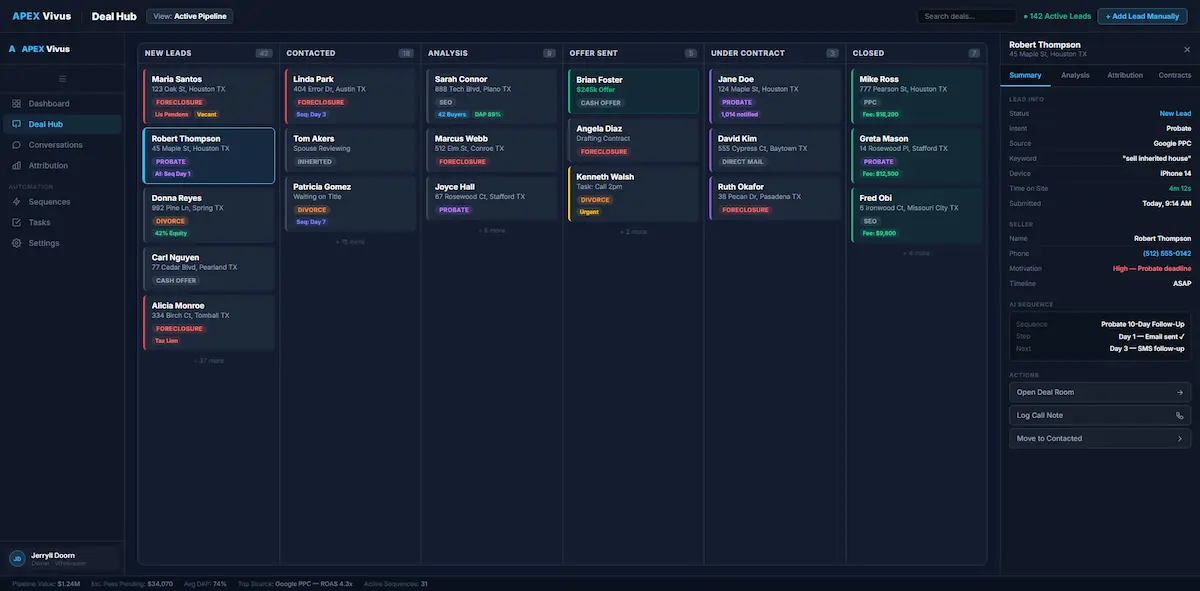
The Apex Vivus CRM board, each seller a card in the column for their stage
The Apex Vivus CRM Each seller is a card that moves from new lead to closed deal. Every call, text and email is on the card.
3

You price the house

What it is worth, and what the owner still owes

Partly

Before you can make an offer you need to know two numbers: what the house will be worth once it is fixed up, called the ARV or after-repair value, and what the owner still owes on it. The ARV comes from comps, short for comparable sales: houses nearby, of a similar size, that sold recently. What the owner owes comes from public records of their mortgage. Get either number wrong and the deal loses money.

What Carrot covers

Carrot covers this step in part. Its CRM pricing page lists "Property Data", which are property reports: 5 a month on the free CRM, 50 on Essential, 100 on Scale and 200 on Team. A report gives you facts about the house. We did not find a tool on Carrot's pricing or plan pages that works out the after-repair value from nearby sales.

What investors use otherwise

Property-data websites, county records, an agent friend for comparable sales.

What Apex Vivus covers

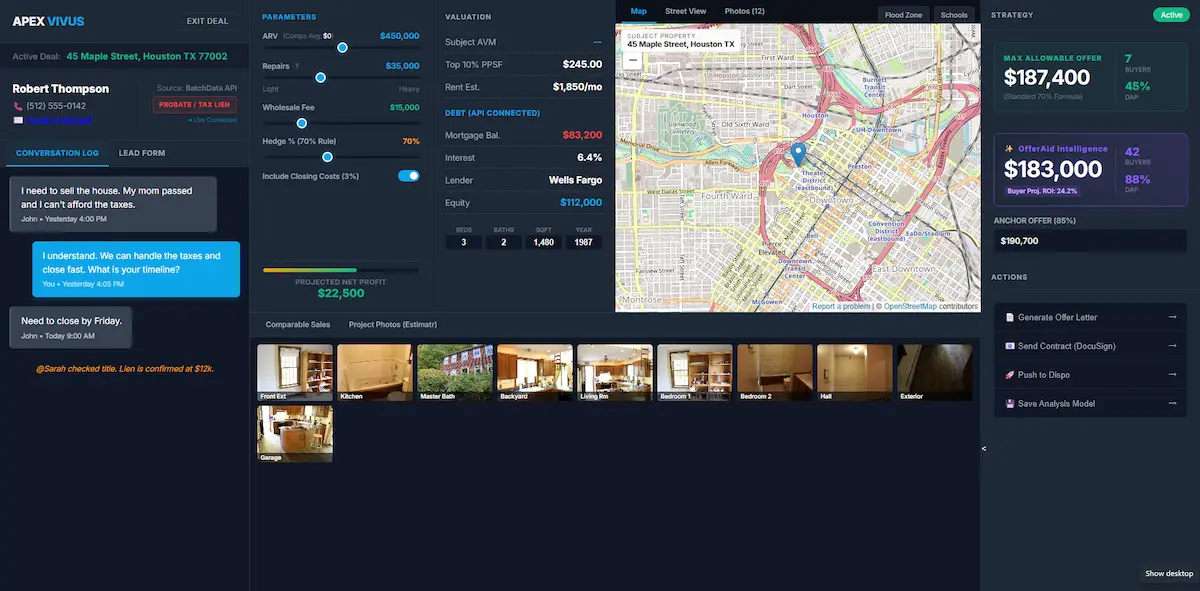
In Apex Vivus every lead can open a Deal Room: one screen with the public records of the house, what the owner owes, and real nearby sales to judge its value, next to the seller's own answers from the form. The repairs, the offer and your fee are worked out from that same screen, so the numbers never have to be typed twice.

The Apex Vivus Deal Room: a house, its records, its value and the deal on one page
The Deal Room One page per house: its records, what it is worth and the deal, from the first look to the contract.
4

You estimate repairs

What the house needs, and what that costs

Not on Carrot's pages

Most houses an investor buys need work: a roof, a kitchen, new floors. What that work costs comes straight off what you can pay, so a repair estimate that is $15,000 too low can turn a good deal into a loss. Investors usually walk through the house, take photos, and price each repair, either from experience, from a contractor, or from a price list they keep.

What Carrot covers

This step is not on Carrot's pages. We did not find a repair-estimating tool on carrot.com/pricing or carrot.com/crm-pricing. That is not a flaw in Carrot's website product; it is simply not what Carrot sells.

What investors use otherwise

A spreadsheet, a contractor's walkthrough, a repair-estimating app.

What Apex Vivus covers

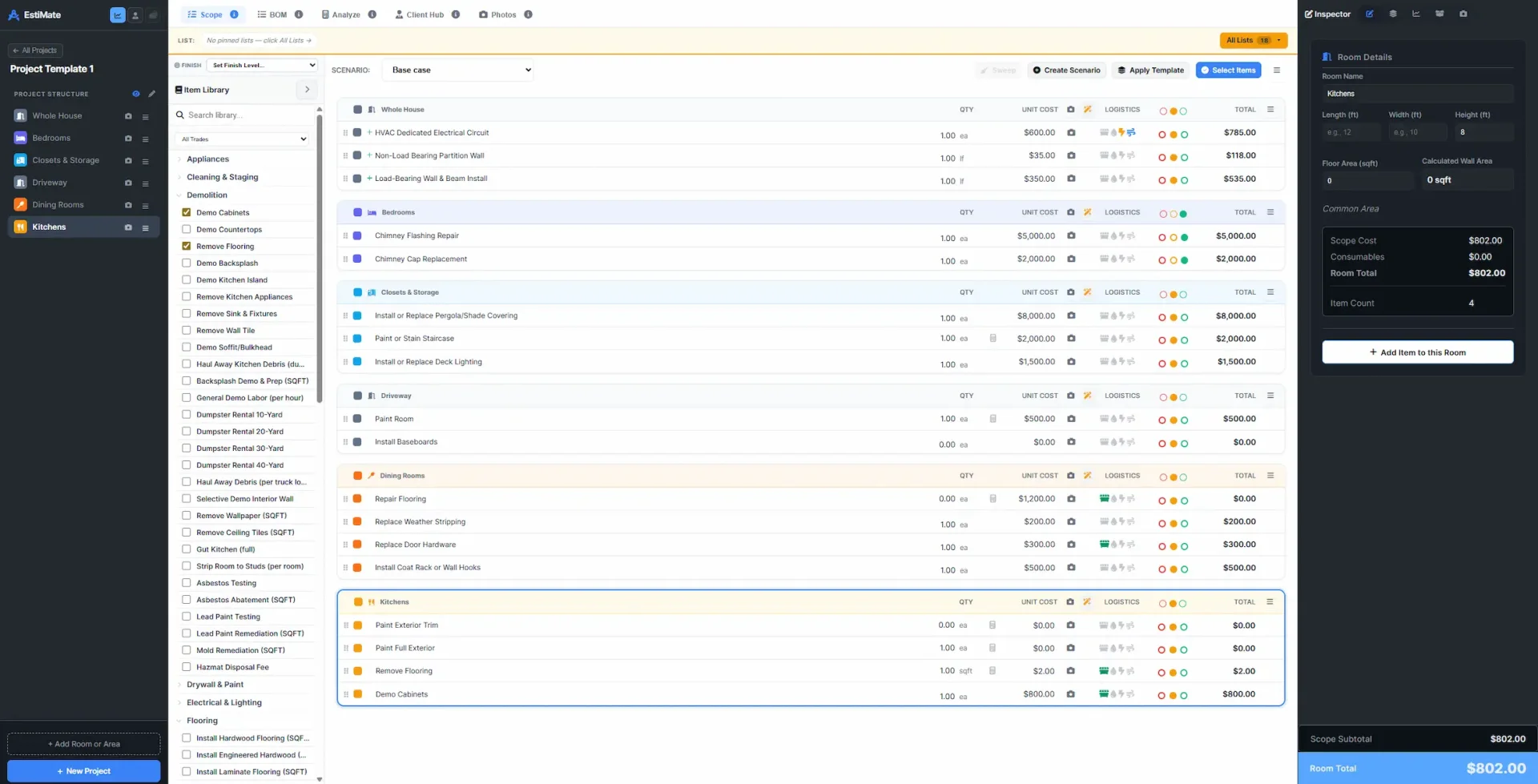
In Apex Vivus, EstiMate prices the repairs. You take photos as you walk through the house, and EstiMate finds the repairs in them and prices each one at your own rates, by room and by line. The total goes straight into the Deal Room, where the offer is worked out. EstiMate Desktop is part of Power-Up; EstiMate Mobile, for walking the house on your phone, is $30 a month more.

EstiMate turning walkthrough photos into priced repair lines
EstiMate Walkthrough photos become priced repair lines, at your own rates.
5

You make the offer

The price you can pay and still make money

Not on Carrot's pages

Your offer is the price you can pay the seller and still make money. Investors often start from a rule of thumb, such as paying 70% of the after-repair value minus the repairs. The trouble with a rule of thumb is that it ignores who will actually buy the house from you, and what they need to earn. Offer too high and no buyer will take the deal; offer too low and the seller says no.

What Carrot covers

This step is not on Carrot's pages. We did not find an offer calculator or offer tool on Carrot's pricing or plan pages.

What investors use otherwise

A rule of thumb, an offer calculator.

What Apex Vivus covers

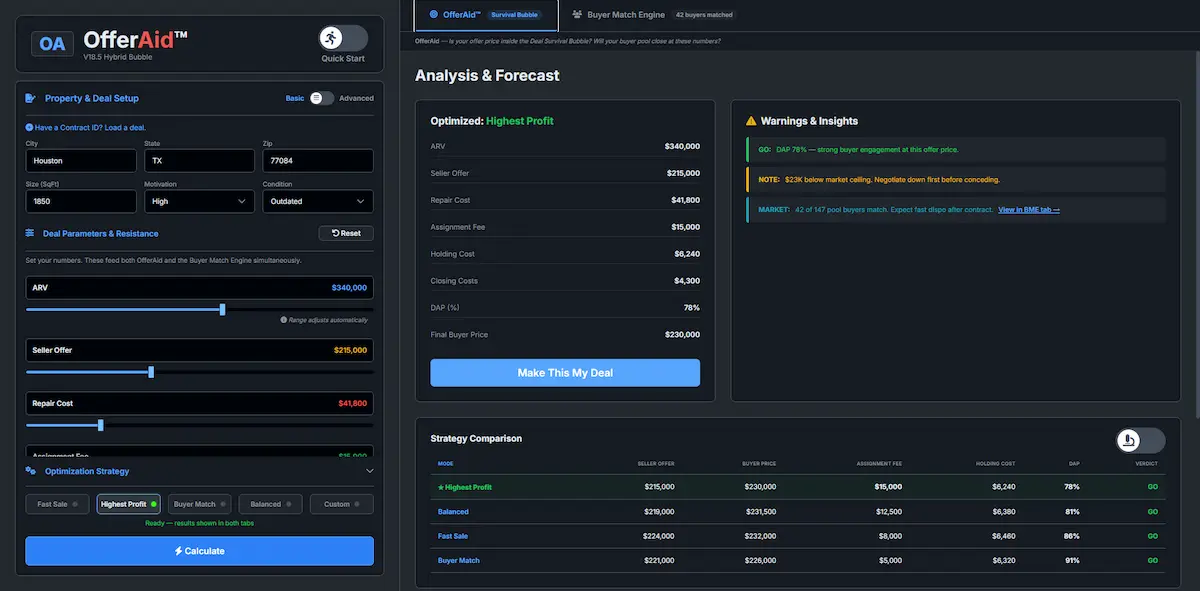
In Apex Vivus, OfferAid works out your offer from the value, the repairs, your fee and what the cash buyers who fit the house need to earn. It lays the offer out so the seller can see how you got to the number, which makes an honest offer easier to accept. OfferAid is part of Power-Up.

OfferAid laying out an offer the seller can read
OfferAid The offer, worked out from the deal and laid out so the seller can follow it.
6

The seller signs

A purchase agreement, signed online

Partly

When the seller says yes, you both sign a purchase agreement: the contract that says you will buy the house at this price, by this date, on these terms. Today most are signed online with an e-signature, a legal signature made on a screen. After signing, a title company, the firm that checks the house has no hidden debts and handles the money at closing, takes it from there.

What Carrot covers

Carrot covers this step in part. Its CRM pricing page lists "Contracts", its e-signature sends: none on the free CRM, 5 a month on Essential ($69), 20 on Scale ($179) and 50 on Team ($349). That is fine for a few deals a month; a team that sends many offers can hit the limit.

What investors use otherwise

An e-signature service, a contract template from a lawyer.

What Apex Vivus covers

Apex Vivus has e-signatures built in, in every plan, with no monthly send limit. You send your own agreement, filled in from the lead, the seller signs online, and when it is signed the lead moves to Under Contract on your board by itself. DealDraft builds the rest of your deal team, such as the title company, lenders and contractors, so you know who to call. Apex Vivus does not write contracts for you; you use your own, ideally checked by a lawyer in your state.

7

You sell the deal

A cash buyer pays you a fee to take over your contract

Not on Carrot's pages

Many investors, especially wholesalers, do not fix the house themselves. They sell their contract to a cash buyer: another investor who pays without a bank loan and takes over the deal. The cash buyer pays the wholesaler an assignment fee for that, which is how the wholesaler gets paid. This step needs two things: a fee the buyer will still accept, and a buyer who wants this kind of house in this place.

What Carrot covers

This step is not on Carrot's pages. We did not find buyer matching, a buyer list or a deal marketplace on Carrot's pricing or plan pages.

What investors use otherwise

Your own buyer list, group chats, deal-listing websites.

What Apex Vivus covers

In Apex Vivus three tools cover it. MaxFee works out the highest fee the deal can carry: it raises your fee $50 at a time against what the buyers who fit can pay, and stops just before they would walk away. Buyer Match finds the cash buyers who fit the house. And the Repository puts the deal in front of REILink's verified cash buyers, free. REILink is the company behind Apex Vivus, and its Repository is free to use.

MaxFee showing the highest fee the cash buyers who fit will pay
MaxFee The highest fee the deal can carry, found against what the buyers who fit can pay.
8

You get paid

The sale closes and the money arrives

Partly

Between the signed contract and the paycheck there are usually two to six weeks: the title search, the buyer's money, the closing date, and any problem that comes up on the way. Keeping track of every deal in that stretch is called transaction management. Losing track of one is how a signed deal falls apart.

What Carrot covers

Carrot covers this step in part. Its CRM pricing page lists transaction management on the $179 Scale and $349 Team plans, not on the free or $69 plans.

What investors use otherwise

A title company's updates, a spreadsheet of deals.

What Apex Vivus covers

In Apex Vivus every plan's pipeline follows the deal past the contract to closing: Under Contract, then Closed, with the deal's notes, documents and messages on the same card. A signed agreement moves the card to Under Contract by itself, so the board shows what is really in the works.

9

The next deal starts smarter

Learning which marketing brought the paycheck

Partly

When a deal closes, the most useful question is: which marketing brought it? Not which ad brought the most leads, but which one brought the lead that became a paycheck. Ad platforms such as Google and Facebook can learn this if you tell them, and then they look for more sellers like that one. This is called sending a conversion back to the ad platform.

What Carrot covers

Carrot covers this step in part. It gives you campaign tracking links, one call tracking number on the website plan, and reports, and its $99-a-month AI Suite adds AI lead scoring. Carrot's own pricing FAQ says it does not run Google or Facebook ads, and does not offer monthly blogging as a service.

What investors use otherwise

The ad platforms' own dashboards, guesswork.

What Apex Vivus covers

In Apex Vivus, when you mark a lead as a closed deal, the profit is sent to your Google and Facebook ads as a conversion, so they learn which seller became a paycheck and look for more like them. Humphrey writes your Facebook Page posts and your Google posts, you approve them, and they publish on schedule. Humphrey Ads, which builds Facebook and Instagram campaigns for you, is releasing in November 2026.

What the gaps cost

What filling the gaps around Carrot really costs.

Filling the gaps around Carrot costs the other tools' prices plus the time spent moving one deal between them. A typical setup looks like the drawing below: the website, then a separate place for each later step, and the same seller typed in again at each one.

The money is easy to add up. Carrot is $119 a month for the website; a CRM for three people is $69 more, for five people $179, for ten $349. Repair, offer and buyer tools are extra, from other companies. Apex Vivus Core is $97 a month for the website, a full CRM for your whole team and marketing; Power-Up, at $147, adds EstiMate Desktop, OfferAid, MaxFee, Buyer Match, SmartMatch and DealDraft.

The time is harder to add up, and it matters more. Each copy of a seller's details is a place for a typo, a missed follow-up or a number that is out of date. When the repair estimate lives in a spreadsheet and the offer in your head, nobody else on your team can check the deal. A good deal is rarely lost to a bad tool; it is lost in the handoff between two tools.

A team of five, per monthWhat it includesPrice
Carrot websiteWebsite, location pages, SEO tools, one tracking number$119
CarrotCRM Scale5 users, 15 sequences, 100 property reports, 20 e-signature sends, transaction management$179
Carrot totalRepairs, offer and buyers still elsewhere$298
Apex Vivus Power-UpWebsite, CRM for every user, marketing, repairs, offer, fee and buyers$147

Carrot prices from carrot.com/pricing and carrot.com/crm-pricing, monthly billing, read 14 November 2026. Apex Vivus from apex.reilink.com/pricing. AI features in both are paid separately: in Apex Vivus they use credits, 80 a month included in Core and 160 in Power-Up, each credit worth 10 cents.

An honest answer

Where Carrot covers a step fully, and where Apex Vivus covers more.

Carrot covers the lead fully and has done it for investors for more than ten years; Apex Vivus covers the lead too, and every step after it. If the website is the only part of the deal you want help with, Carrot may be all you need. Both lists are below.

Where Carrot is strong
  • Websites built for investors, with 50 location pages and SEO tools in the base plan
  • More than ten years of focus on getting investor sites found on Google
  • Training and support its customers praise
  • A free CRM for one person, texting and email included
  • No setup fee and a 30-day money-back guarantee
Where Apex Vivus covers more
  • Repairs, the offer, your fee and the buyer, each with its own tool
  • A full CRM for every user in every plan, with automatic replies to new sellers
  • E-signatures with no monthly send limit
  • Your ads told which seller became a paycheck
  • Your social posts and Google Business Profile run from the same place

Who should stay on Carrot? An investor who wants a proven website and is happy with how they handle the rest, perhaps with an experienced partner who prices the deals, or a buyer list they already trust. Who should look at Apex Vivus? An investor, or a team, who wants the whole deal in one place, with each step done by a tool built for it, and with the steps explained for someone still learning them.

What Apex Vivus does not have yet. Apex Vivus is newer than Carrot and has far fewer public reviews. Humphrey Ads, which builds Facebook and Instagram campaigns for you, is releasing in November 2026 and is not available today. The Carrot alternative comparison sets the two side by side, feature by feature, and our Carrot review counts what Carrot's own customers say.

Questions about what Carrot does

What Carrot does and doesn't do, answered.

What does Carrot do?

Carrot builds websites for real estate investors and agents, and gets them found on Google. Its $119-a-month plan includes an AI website builder, 50 location pages, SEO tools, one call tracking number and a free CRM for one person. Paid CRM plans, from $69 to $349 a month, add more users, more follow-up, property reports, e-signatures and, from $179, transaction management.

What doesn't Carrot do?

Carrot doesn't, on its own pricing and plan pages, estimate repairs, work out your offer, set your assignment fee or find you a cash buyer for the deal. Its FAQ also says Carrot does not run Google or Facebook ads, and it does not offer monthly blogging as a service. Pricing the house, signing the contract and closing are covered only in part, with monthly limits by plan.

Does Carrot have a dialer?

Carrot doesn't list a dialer on its CRM pricing page. Texting and email are included in every CRM plan, and the $179 and $349 plans add "Inbound Call Popups", which show who is calling. Calling out to sellers is done from your own phone or a separate dialer app.

Does Carrot give me comps?

Carrot gives you property reports, which it calls "Property Data": 5 a month on the free CRM, then 50, 100 or 200 a month on the paid plans. A comp, short for a comparable sale, is a nearby house that sold recently, and it is how you judge what a house is worth. Beyond those reports, investors use property-data websites and county records.

Does Carrot help me estimate repairs?

Carrot doesn't help with repair estimates: we did not find a repair-estimating tool on its pricing or plan pages. Investors on Carrot usually estimate repairs with a spreadsheet, a contractor's walkthrough or a separate app. In Apex Vivus, EstiMate prices the repairs from your walkthrough photos at your own rates.

Does Carrot have e-signatures?

Carrot has e-signatures on its paid CRM plans, called "Contracts": 5 sends a month for $69, 20 for $179 and 50 for $349. The free CRM has none. Apex Vivus has e-signatures built in, with no monthly send limit: you send your own agreement, filled in from the lead, and the seller signs online.

Does Carrot help me find a cash buyer?

Carrot doesn't help you find a cash buyer for the deal: we did not find buyer matching, a buyer list or a deal marketplace on its pricing or plan pages. A cash buyer is an investor who pays without a bank loan, and in wholesaling they pay you a fee to take over your contract. Apex Vivus matches the house to cash buyers and puts the deal in front of REILink's verified cash buyers, free.

Does Carrot run Facebook or Google ads for me?

Carrot doesn't run Facebook or Google ads: its own pricing FAQ says so. It gives you tracking links and a call tracking number to measure the marketing you run. Apex Vivus tells your Google and Facebook ads which seller became a paycheck when a deal closes, and Humphrey Ads, which builds Facebook and Instagram campaigns for you, is releasing in November 2026.

Does Carrot manage my social media or Google Business Profile?

Carrot doesn't mention social media or Google Business Profile management on its pricing page. In Apex Vivus, Humphrey writes your Facebook posts, you approve them and they publish on schedule, and your Google Business Profile, the listing sellers see on Google Maps, is run from the same dashboard.

Is Carrot enough for a beginner?

Carrot can be enough for a beginner who mainly needs a website that brings leads and is happy to do the rest by hand. You will still need a way to price houses, estimate repairs, make offers and find buyers, which on Carrot means other apps, spreadsheets or people. A beginner who wants every step in one place, with the steps explained, may find that harder to piece together.

How much does it cost to fill the gaps around Carrot?

Filling the gaps around Carrot costs whatever the other tools cost, plus your time moving the same deal between them. Carrot itself is $119 a month for the website, plus $69 to $349 a month for a CRM for a team. Apex Vivus Core, the website and a full CRM for unlimited users, is $97 a month, and Power-Up, with the deal tools, is $147.

Who wrote this, and are you neutral?

This was written by Jerryll Noorden for Apex Vivus, which competes with Carrot, so we are not neutral. That is why every Carrot fact here comes from Carrot's own pricing pages, with links, why we mark the steps Carrot covers fully, and why "not on Carrot's pages" means only that we did not find it there.


Sources

Where every fact comes from.

  1. carrot.com/pricing: the website plans, what each includes, add-ons and the pricing FAQ (no Google or Facebook ads, no monthly blogging service). Read 14 November 2026.
  2. carrot.com/crm-pricing: CarrotCRM's four plans, users, sequences, property reports, e-signature sends and which plans have workflows, autoresponders, call pop-ups and transaction management. Read 14 November 2026.
  3. Apex Vivus pricing: Core $97 a month, Power-Up $147 a month, credits included. Read 14 November 2026.
  4. Carrot pricing in 2026, our guide to every Carrot plan and limit. Updated 14 November 2026.
  5. Carrot review 2026, our count of 49 public reviews of Carrot. Read 14 November 2026.
  6. What is Apex Vivus?, each Apex Vivus tool explained on its own. Updated 14 November 2026.
Jerryll Noorden
Jerryll NoordenFormer NASA robotics scientist who has bought houses in Connecticut since 2016. Started his investing business on Carrot, then built Apex Vivus, so he has used both. How he moved his own site from Carrot.

Want every step after the lead in one place? See how the move works.

If you are on Carrot and want the whole deal in one place, the move to Apex Vivus is free. Your pages, blog posts, pictures and leads come with you, at the same web addresses, and your new site is built and checked before anything changes.

Compare

Keep exploring