SolutionsWholesalersInvestors / FlippersAgentsContractors
How It WorksAttractUnderstandOperateConnect
HumphreyMeet HumphreyIAAsk Humphrey
Why ApexWall of ProofComparisonsGreater Than the Sum
LearnFree CourseBlogAbout Apex Vivus
PricingSee pricing
The whole system, explained

One motivated seller in. One closed assignment out. See how every tool in between fits together. One off-market lead in. The right exit out. See how every tool in between fits together. One homeowner inquiry in. One signed listing out. See how every tool in between fits together. One curious homeowner in. One pre-sold job out. See how every tool in between fits together.

EstiMate, MaxFee, Repository, Apex — a lot of names, one connected system. Click any card in the flow chart below to see what it does, what it receives, and what it sends downstream. The system stays the same; only your role changes.

The whole picture

REILink vs Apex Vivus

REILink is the toolbox.
Apex is what makes the tools work together.

Picture a garage filled with tools — wrenches, screwdrivers, drills — and a mechanic who reaches for each one in the right order, in the right sequence, at the exact moment the job calls for it. But that's not all he does: he's also the one who brings customers in — greeting them, building credibility and competence, and nurturing them until they choose his shop over any other. Now imagine that garage is called REILink, and that mechanic has Apex stitched across the name tag on his overalls.

Each tool on that wall is a standalone engine. EstiMate runs without OfferAid, OfferAid without MaxFee — pick any one up and use it alone, no other CRM or stack required.

But they were built from day one to hand work to each other through one shared intelligence layer — no duct-taped integrations, no Zapier spaghetti. Apex is the mechanic working that line: it moves data between tools, fires the right sequence at the right moment, and ties every outcome back to what produced it — showing up as your site, CRM, workflow, sequencing, and attribution all at once.

REILink
SmartForms
Intent-aware lead capture
EstiMate
Photo → repair scope
OfferAid & BuyerMatch
Offer math · buyer routing
MaxFee
Assignment fee survival
Apex Vivus
Site · CRM · automation
orchestration · attribution
Deal Room
Centralized deal hub
Repository
Smart buyer routing
Design Studio
Homeowner pre-sale
AdSync
Revenue attribution · closes the loop
REConnect
Job market · investors & contractors
PageForge
SEO expansion from what closed

REILink is the toolbox. Apex is what makes the tools work together.

The life of one lead

Now watch one lead move through it.

The path below is what happens when one real lead arrives. Click any card to see exactly what it does at that moment in the deal.

AdSync
Traces revenue back to ad, keyword, page
PageForge
SEO pages spawned from what closed

Everything you just watched happened on its own — because one intelligence ran the whole board, every handoff, start to finish.

That intelligence has a name — I'm Humphrey. I ran every step you just watched. Ask me anything about how it works — REILink, Apex, EstiMate.

Humphrey
online

Want the full picture? See everything Humphrey can do →

What this means for you

That's what just played out in the flow chart. Here's why it works that way — and what your business looks like without it.

Without shared intelligence
  • Data fractures across tools
  • Workflows fragment between systems
  • Attribution breaks at every handoff
  • Users re-enter the same information
  • Systems become blind to each other
  • Operators become the integration layer
With Apex
  • Data carries forward at every stage
  • Workflows compound across the lifecycle
  • Attribution survives from click to close
  • Information is entered once, used everywhere
  • Each system inherits context from the last
  • The platform is the integration layer

That's why every tool sits at a specific point in the deal. Not because they're random products — but because each one hands off to the next.

REILink vs Apex Vivus

The muscle, and the brain.

Two halves of one system. One generates the raw power. The other turns it into coherent operational decisions.

Apex Vivus — The brain

The operating system that runs it.

Inside REILink, Apex Vivus is the layer that decides what runs when. Which lead goes where, who sees what, what gets followed up, what gets prioritized, what gets attributed. The muscle without the brain is just a pile of tools — and the brain has a name: Humphrey, the intelligence watching every tool at once and deciding what happens next. It's the reason all of this runs on its own.

  • Workflow orchestration across every tool
  • The shared property record, lead history, and context
  • Attribution that survives every handoff
  • The learning loop that improves every next deal

The muscle gives you capability. The brain gives you continuity. Together, you get an operating system instead of a software stack.

Owning the tools vs. running on Apex

The whole is greater than the sum of its parts.

Every REILink tool works on its own. If all you want is MaxFee to size your assignment fee, grab the package that includes it on REILink.com and use it — no CRM, no stack, no Apex required. The tools are real, and each one works alone.

So what does Apex actually add? It's tempting to picture all the tools in one place with a manager keeping them in sync. That's not it. Apex adds the one thing no single tool can have — the whole picture. Humphrey watches every tool at once, so it catches what only shows up in between them. The intelligence doesn't live inside any one tool; it lives in what a single mind can notice across all of them.

Take one job — writing a social post.

A writer, on its own
Cash Home Buyers
2h ·
We buy houses — any condition, any situation. Fast cash offer, close in days. Call today!
👍 2No comments

It was told to write a post, so it wrote one — for everyone, which means it lands with no one. It has nothing to work from but your instruction.

Humphrey isn't working from your instruction. It's working from everything it has already watched across your business:

Seller messages"It's my dad's house — packed to the ceiling. I just can't deal with it." These sellers keep describing being buried by the stuff. Notice what they never bring up: the price.
Scroll & heatmapOn your site, they stop and linger on the line about "we handle the cleanout — leave what you don't want" — and scroll right past the offer amount.
Closed dealsAnd the ones who actually signed? They chose you out of relief that you'd take it off their hands — not because you bid the highest number.
Humphrey reads all three at once — and sees the pattern no single tool was even looking at.
What Humphrey concludesThese sellers aren't blocked by your price. They're blocked by the overwhelm and the shame of the mess. You win them by taking it off their hands — not by bidding higher. So that's the angle the post needs to lead with.
The same writer — now
Cash Home Buyers
2h ·
Inherited a house packed wall-to-wall? Leave every box where it sits. We clear it out, handle the cleanup, zero judgment — and you still walk away with cash.
👍❤️ 31247 comments · 23 shares

Same writer. Same tool. But now it knows exactly who it's writing to and why they'll choose you. That insight never came from the writer — it couldn't; the writer never saw the messages, the scrolling, or the deal history. It came from one awareness sitting over all of it.

A standalone tool does what you ask. Humphrey notices what you'd never have known to ask for.

The architectural why

Most operators are forced into one of two broken models.

Before you understand why Apex looks the way it does — it helps to see what it's reacting against.

Model #1

The bloated all-in-one.

Everything technically exists in one place. But most tools are shallow, generic, and disconnected from each other internally — even though they share a login screen. You compromise depth for the illusion of convenience.

  • Generic features, shallow workflows
  • Tools that don't actually talk inside the platform
  • You outgrow it within twelve months
Model #2

The fragmented specialist stack.

You assemble best-in-class tools yourself. CRM here, website there, estimating somewhere else, spreadsheets gluing it all together, Zapier failing quietly in the background. You don't have a system — you are the system.

  • You re-enter the same data four times
  • Attribution breaks the moment a tool changes
  • The integration layer is your brain
Apex is solving a different problem entirely.

The point isn't "many tools under one brand." The point is specialized systems on one shared intelligence layer.

Each tool in REILink is a deep, standalone system — built to do its specific job better than a generic all-in-one ever could. But unlike a specialist stack, they're not assembled by you. They're built on the same operational layer underneath, which means they share the same property record, the same lead history, the same attribution data, and the same workflow state. The website knows what happened in the CRM. The CRM knows what happened in EstiMate. The Deal Room inherits both. You are no longer the integration layer.

Every layer in the system shares
The same operational context
The same property record
The same lead history
The same attribution data
The same workflow state
The same user intelligence
This is not "integration."
This is operational continuity across the entire lifecycle of the deal.
That is the Operating System.
Product roles

Where each part of the system actually sits.

Fourteen connected layers. Each one solves a different problem. Each one feeds the next.

Operating system

Apex Vivus

The business engine. Websites, CRM, automation, follow-up, attribution, deal workflows — the operational brain that runs the day.

WhoInvestors, agents, contractors, wholesalers
Sits atCenter of the stack
Learn more
Intake layer

SmartForms

Intake forms that adapt to what they're collecting — property condition, seller motivation, homeowner intent. Captures structured signal instead of contact info, then feeds it directly into the CRM as an enriched lead profile.

WhoInvestors, wholesalers, agents, contractors
Sits atLead capture / website edge
Learn more
Estimating intelligence

EstiMate

Turns photos and scopes into repair numbers and contractor-priced bid packages. Mobile for walk-throughs. Desktop for pre-uploaded photo sets.

WhoInvestors, wholesalers, contractors
Sits atProperty intelligence stage
Learn more
Visual selling layer

Design Studio

Where homeowners design their own remodel, see finishes rendered, and arrive pre-sold on a tier and price range before any conversation.

WhoContractors and their homeowners
Sits atWebsite / homeowner engagement
Learn more
Deal decision layer

Deal Room

Where a property becomes a structured deal — scope, repair numbers, photos, offer logic, buyer presentation, and documents in one record.

WhoWholesalers, investors, buyers
Sits atProperty-to-transaction stage
Learn more
Fee ceiling layer

MaxFee

Tests assignment fee against historical buyer drop-off curves to find the highest fee the deal can carry without losing buyer interest. The ceiling, not a guess. Feeds the survival math.

WhoWholesalers
Sits atDeal pricing stage
Learn more
Deal scenario layer

OfferAid

Builds the survival bubble — the offer-price range where the deal stays profitable across every exit. Models flip, BRRRR, rental, and wholesale simultaneously. Constructs the actual offer based on what buyer behavior will support, not what the seller might accept.

WhoInvestors, wholesalers
Sits atDeal decision stage
Learn more
Buyer routing layer

BuyerMatch

Matches deals to the buyers most likely to close them — based on actual purchase history, deal-type behavior, and engagement patterns. Pairs with OfferAid so the offer is built against the real buyers who'd take it.

WhoWholesalers, investors
Sits atBuyer matching layer
Learn more
Distribution layer

Repository

Where wholesalers post deals and cash buyers shop them. Filtered by buy box, location, return profile — and matched to the right buyers automatically.

WhoWholesalers, cash buyers, investors
Sits atBuyer matching / distribution
Learn more
Connection layer

REConnect

Where contractor profiles meet investor projects. Investors post jobs from their Deal Room, contractors get matched, bids come back through one inbox.

WhoContractors, flippers, investors
Sits atExecution stage
Learn more
Learning layer

AdSync

True attribution — campaign sync, cross-channel tracking, and revenue tracing. Shows which ad actually closed which deal, not just which one got the click.

WhoSerious operators across every audience
Sits atBefore and after the deal
Learn more
SEO expansion layer

PageForge

The output of the attribution loop. AdSync identifies which keywords, geographies, and seller patterns actually closed — and PageForge generates SEO pages aimed at exactly those patterns. Marketing compounds around what actually produced ROI, not generic content.

WhoInvestors, wholesalers, agents, contractors
Sits atSEO / acquisition expansion
Learn more
Acquisition engine

REILink Education

A library of courses — wholesaling, SEO, business setup, and more — that brings new operators into the network from multiple entry points. Education funnels into deal flow, buyer activity, and Apex upgrades over time.

WhoNew operators across every audience
Sits atREILink network entry
Learn more

…and growing

New engines join the ecosystem regularly — and every one plugs into the same shared intelligence.

The Command Center

The Deal Room is where everything converges.The Deal Room runs every exit simultaneously.The Agent Deal Room knows everything before you ask.Apex Construct opens with the job already pre-sold.

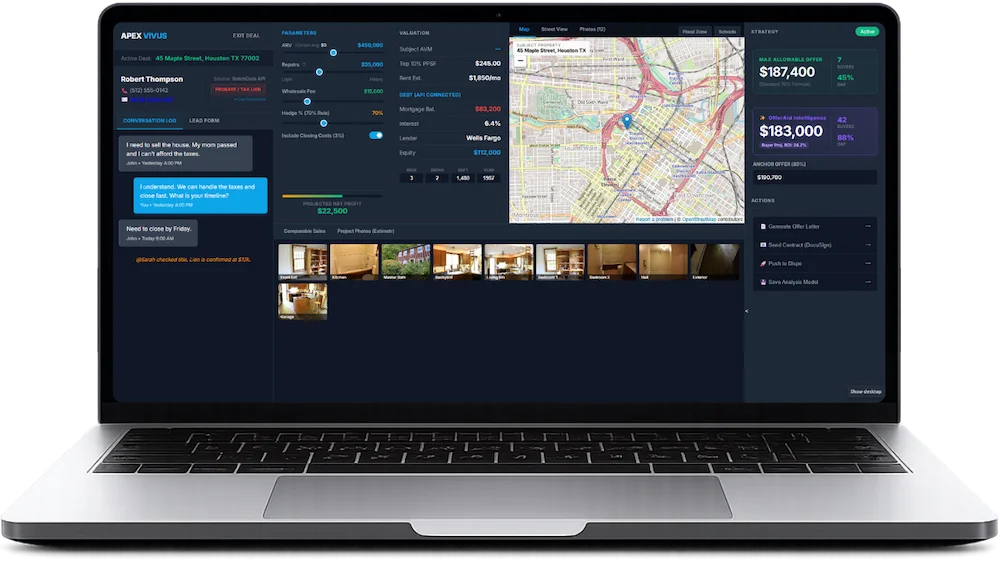
Every tool in the system -- CRM, OfferAid™, EstiMate™, MaxFee™, Buyer Match, DocuSign, Repository -- feeds into and fires from the Deal Room. One screen. Every decision.

You open a deal. Property data is already loaded. Analysis is running. Buyers are matched. Your job is to decide and act.

🏦
Live Property Intelligence
AVM, mortgage balance, equity, debt stack, comps, and rent estimates -- pulled automatically the moment you open a deal.
OfferAid™ -- GO / TIGHT / STOP
Real-time deal viability scored against your buyer network. Know your DAP before you make the call.
📧
DocuSign -- 1 Click
Generate the offer letter and fire the contract without leaving the screen. No switching apps. One click.
🚀
Signed contract? One click distributes to your top matched buyers. Dispo starts immediately.

Flip, BRRRR, Rental, Wholesale -- all four exits analyzed simultaneously before you commit. Every data point loads automatically. You compare returns, not spreadsheets.

You open a deal. ARV, equity, repair scope, and exit projections are already there. Your job is to pick the best path -- and act.

📊
Multi-Strategy Simulator
Flip profit, BRRRR equity recapture, rental cash-on-cash, wholesale fee -- all four exits calculated simultaneously from live data.
🔧
Computer vision scans your walkthrough photos. Line-item repair scope generated automatically -- no contractor call required.
📧
DocuSign -- 1 Click
Generate the offer letter and fire the contract without leaving the screen. One click from the Deal Room.
🔄
Attribution Feedback Loop
Every closed deal traces back to its source ad. Your criteria sharpens. Deal 20 closes faster than deal 1.

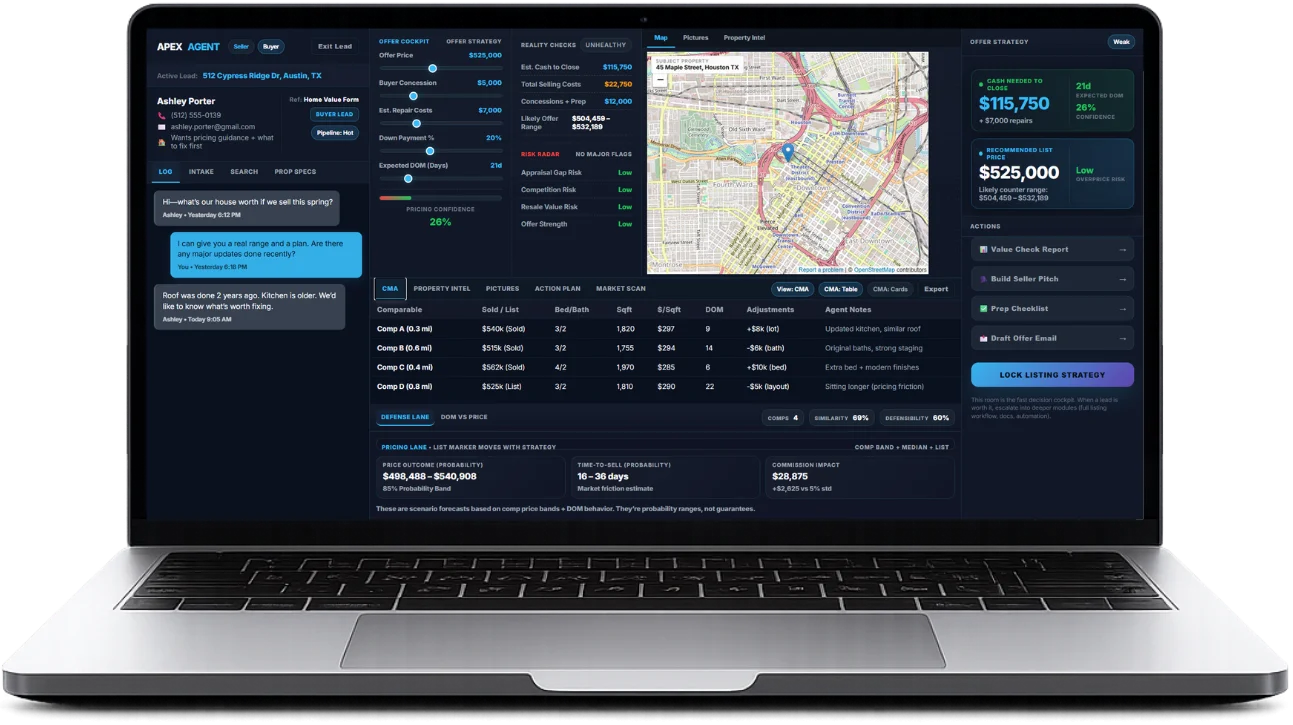
The Agent War Room loads your full CMA, pricing simulation, risk flags, and likely offer range before you walk into the appointment. You show up with answers — not questions.

You open a lead. Comps are already pulled. The Pricing Simulator has run three list strategies. Risk Radar has flagged overpricing pressure. Your recommended price is waiting.

💰
Pricing Simulator
Models three list strategies — aggressive, market, and conservative — with projected DOM, concession risk, and estimated net proceeds for each.
⚠️
Risk Radar
Flags overpricing risk, appraisal pressure, showing friction, and negotiation exposure — so you walk in knowing where the deal could break.
📊
Live CMA + Comp Defense
Comparable sales pulled automatically. Similarity scores, adjustment leverage, and a talk-track built for each comp — ready before you sit down.
📋
Action Plan Generator
CMA packet, seller pitch, prep checklist, and listing strategy locked in one click. No manual prep. No missed steps.

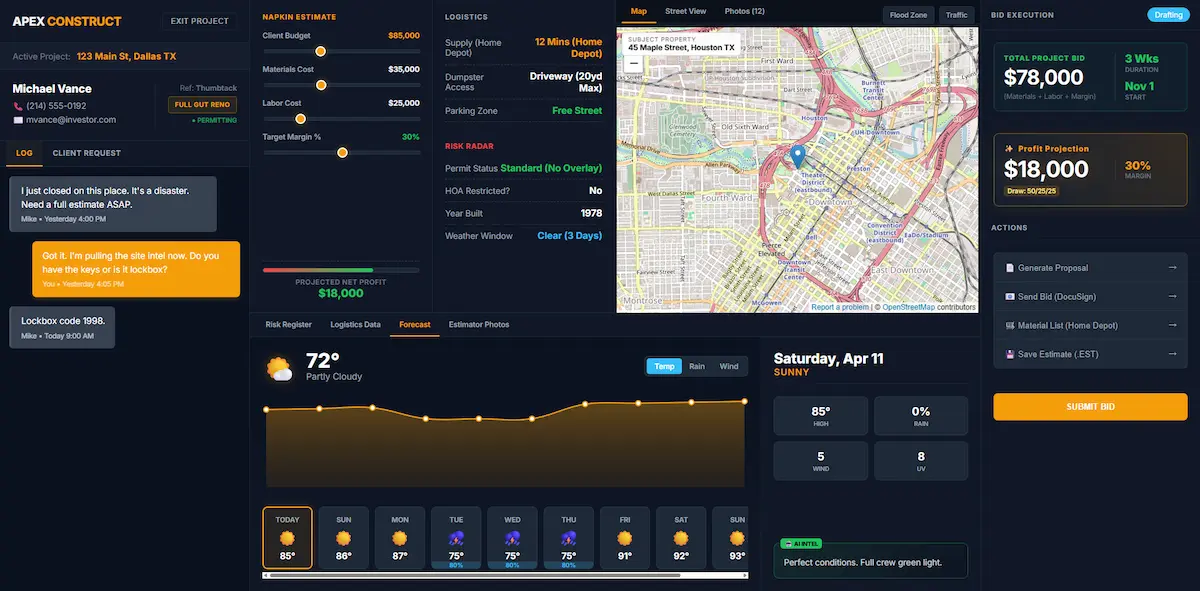
The scope is already built. The photos are already attached. The budget is already confirmed. The prospect designed their space, agreed to the price, and qualified themselves -- before you knew they existed.

You open Apex Construct. Your only job is to verify the details and send the contract.
📋
Pre-Built Scope
Every line item -- materials, labor, quantities -- built from the prospect's Design Studio selections. Your SKU list. Your margin. Protected.
⚠️
Risk Radar
Permit requirements, year-built hazard flags, and site complexity signals -- identified automatically before you commit to the job.
📧
DocuSign -- 1 Click
Generate the proposal and fire the contract without leaving Apex Construct. No switching apps. One click.
📈
Bid Accuracy Feedback
Every closed job records final vs bid. The system learns. Your margin protection improves with every project.
Apex Deal Room — wholesaler command center with live property intelligence, OfferAid DAP scoring, and one-click contract generation
Apex Agent War Room — pricing simulator, risk radar, CMA, and listing strategy loaded before your first call
Apex Construct — contractor command center with pre-built scope and confirmed budget
What this changes

What your day actually looks like

Same amount of work. Less friction. Better results.

Without an integrated system
-Lead arrives as an email. Manually entered.
-You decide who to call first. Based on feel.
-Open 4-5 tabs to research the property.
-Build the offer in a spreadsheet. Manually.
-Email your buyer list. Hope someone responds.
-Deal closes. No idea which ad produced it.
With Apex
+Lead enters CRM, scored and routed automatically.
+Pipeline sorted by close probability. Always.
+Deal Room opens with all data already loaded.
+OfferAid calculates the offer. DAP scored live.
+Top matched buyers notified. Ranked by fit.
+Deal closes. Source attributed. Next deal smarter.
Without an integrated system
-Deal comes in. You research it across 4 tools.
-You run one exit. Hope it's the right one.
-Call your contractor for a repair estimate. Wait.
-Build the offer in a spreadsheet from scratch.
-You close. No idea which source produced this deal.
With Apex
+Deal Room loads all data before you ask.
+All four exits run simultaneously. Best one surfaces.
+EstiMate generates repair scope from photos. Instant.
+Offer built from live data. DocuSign in 1 click.
+Close attributed to source. Next deal criteria sharpened.
Without an integrated system
-Homeowner calls cold. You know nothing about the property.
-Schedule a site visit just to gather basic info.
-Pull comps manually. Build a CMA from scratch.
-Fixer-upper lists "as-is." Sits on market for 90 days.
-Listing closes. No idea which campaign produced the lead.
With Apex
+Homeowner builds their own profile before you call.
+Agent Deal Room loads pricing, comps, and risk data.
+Pricing Simulator models DOM and concessions instantly.
+AI renders the fixer-upper in 3 tiers. "As-is" becomes priced.
+Commission attributed to exact ad. Next cycle smarter.
Without a system
-Contact form submits. Name and phone. Nothing else.
-Drive to site. Spend an hour measuring and noting.
-Spend 3 hours building the quote. Send a PDF.
-"That's too expensive." Or silence. Time wasted.
-Compete on price with 3 other contractors.
With Apex
+Prospect scans QR. Wizard captures scope on their phone.
+AI prices the job against your SKU list. Instantly.
+They see the render. They set their own budget.
+Pre-sold lead arrives. Scope built. Budget confirmed.
+You verify and sign. No site visit. No negotiation.
The Compounding System

Every close makes the next dealdeallistingjob better. Here's how.

Most tools do the same job on deal 50 as they did on deal 1. Apex doesn't — because Humphrey remembers what worked. Every close feeds back into the system, making your lead quality, analysis accuracy, and ad spend sharper each time.

📣
Ad spend gets sharper
The exact keyword, ad creative, and campaign that produced the closed deal is identified and fed back to your ad platforms automatically. Your budget shifts toward what actually closes -- not what just generates leads.
🧠
Lead scoring gets smarter
Every time a lead closes, the CRM learns what that profile looked like -- motivation signal, timeline, form behavior, source. Future leads that match that pattern get scored higher and surfaced faster. Your hottest leads get to the top quicker every cycle.
🎯
Buyer matching improves Exit accuracy sharpens Listing conversion improves Bid accuracy compounds
When a buyer closes on a deal, their profile is updated — deal type, price range, location, speed. The next matching deal ranks them higher in SmartMatch results. Every deal you close teaches the system which exit produced the best return for that property type and market. Future analysis weights toward what actually worked. Every listing closed improves follow-up timing and pricing accuracy for the next similar property. Your conversion rate improves without changing your approach. Every closed job records final vs bid. The system learns where your estimates run tight. Future scopes are more accurate — and your margin protection improves.
SmartMatch™ Ranking Exit Intelligence Conversion Intelligence Bid Accuracy Loop
💡
Offer accuracy sharpens Deal criteria sharpens Pricing accuracy improves Scope intelligence grows
OfferAid's DAP scoring gets calibrated against real closed outcomes. Your offer range tightens. You pay less when the deal is weak and more when it's strong — automatically. Every closed deal refines your buy box criteria — ARV range, equity threshold, deal type, market. Future leads are scored against a sharper filter that reflects what actually works for you. Your condition-adjusted valuation model improves with every listing closed. Pricing Simulator recommendations get more accurate over time — less negotiation, better list-to-close ratio. Material costs, labor rates, and waste factors update from real job data. The scope your prospects see tomorrow is priced from what you actually spent last month — not estimates.
OfferAid DAP Calibration Buy Box Refinement Pricing Model Calibration Pricing Intelligence Loop
🏙️
Local market intelligence grows
Closed deals in your market build a local comps model that improves valuations, buyer match accuracy, and days-on-market predictions over time — specific to your geography.
Tools do the same job every time. An OS learns. Deal 50 closes faster, more accurately, and with better returns than deal 1 — automatically. That gap is the compounding effect of a connected system.
What this replaces

One integrated system. Not five disconnected tools.

Before Apex, closing a deal required five separate products, manual hand-offs, and you as the connection between all of them. Before Apex, analyzing a deal meant opening five tools, calling your contractor, and still guessing on half the numbers. Before Apex, a listing presentation meant manually pulling comps, building a CMA from scratch, and walking in hoping the number sticks. Before Apex, every quote meant a site visit, 3 hours of spreadsheet work, and a PDF that usually went silent.

The old way
Website builder (doesn't talk to CRM)
Separate CRM (doesn't know the deal)
Spreadsheet for deal analysis
Third-party estimator tool
InvestorLift / PropStream for dispo
DocuSign — separate login
You as the connection between systems
Attribution guesswork
Propstream for property data
Separate spreadsheet per exit strategy
Contractor call for repair estimate
Separate rent estimator
Manual offer letter + DocuSign
No feedback loop on what works
Homeowner calls cold — zero context
Site visit just to gather basic info
Manual CMA from scratch
Fixer-uppers listed "as-is" and sit
No idea which ad produced the lead
Every cycle repeats the same guesswork
Contact form — name and phone only
Drive to site just to gather info
3 hours building a spreadsheet quote
Send PDF — hear nothing back
Compete on price with 3 others
Margin negotiated away on every job
One system. Every stage connected.
AI Website + SmartForms
CRM — self-scoring, self-routing
Deal Room — all data in one screen
OfferAid™ + EstiMate™ built in
Live buyer network + Repository
DocuSign — 1 click from Deal Room
True attribution — ad to closed deal
Deal Room — all data loads automatically
Multi-Strategy Simulator — all 4 exits
EstiMate™ — instant repair scope from photos
Strategy Battle Simulator
DocuSign — 1 click from Deal Room
Attribution feedback loop
Photo intake wizard — profile built before you call
Agent Deal Room — pricing + risk loaded
Pricing Simulator + Risk Radar
AI Vision renders on seller's own photos
True attribution — ad to commission
Design Studio — prospect pre-sells themselves
AI scope from photo — your SKU list, your margin
Apex Construct — scope + budget confirmed on arrival
DocuSign — 1 click from Apex Construct
Bid accuracy compounds every job
Pick your entry point

Now you know where everything fits.

Walk through the part of the ecosystem that matches your business.

FAQ

Questions, answered.

The short version of how Apex turns one lead into one closed deal.

What is Apex?

Apex is an AI real estate operating system that runs one connected workflow — website, CRM, deal analysis, buyer matching, contract delivery and ad attribution — on a single shared intelligence, so a lead moves from first click to closed deal without ever leaving the system.

How does a lead actually move through Apex?

A lead enters through your site or a SmartForm, gets scored and enriched in the CRM, becomes a structured deal in the Deal Room with repair scope and offer logic, is matched to verified cash buyers, and closes — and every step feeds the next one.

Who is Apex built for?

Wholesalers, investors and flippers, agents, and contractors. The page adapts to each role, and the same shared system serves all of them inside one network.

How is Apex different from using separate tools?

Separate tools each see one slice of your business and don't share data, so you become the integration layer. Apex shares one record and one intelligence across every tool, so context is never lost and the system gets smarter with every closed deal.

What is the Deal Room?

The Deal Room is where a property becomes a structured deal — repair scope, mortgage and equity data, offer logic across every exit, matched buyers, and documents — all in one live record you control.