How to organize a wholesale deal pipeline: the stages, the follow-up and the numbers that matter.
Updated · About 20 minutes to read
To organize a wholesale deal pipeline, give every seller lead one stage out of nine (new lead, contacted, qualified, appointment set, offer made, under contract, marketing to buyers, assigned, closed), write a rule for entering and leaving each stage, give every lead a next action with a date, put sellers who are not ready into a follow-up lane on a fixed schedule, record where every lead came from, and review the whole board once a week.
If you are new: a lead is a homeowner who might sell to you; a pipeline is the path every lead walks, stage by stage, until it becomes a closed deal or is let go. Organizing it means no seller is ever forgotten, and you can see exactly where your deals leak.
What is a wholesale deal pipeline, and why does it matter so much?
A wholesale deal pipeline is the ordered set of stages every seller lead moves through, from the first contact to a closed deal, where each stage has a rule for entering it, a rule for leaving it, a person responsible and a next action with a date.
Wholesaling is a follow-up business. Very few sellers say yes the first time you talk: they are comparing offers, waiting for a relative to agree, or not ready until something changes (a tenant leaves, a probate court signs, a winter bill arrives). The wholesaler who is still in touch, politely, when that change happens gets the contract. A pipeline is how you are still in touch with five hundred sellers without remembering any of them.
It also tells you the truth about your business. When every lead sits in a stage, you can see where deals leak: plenty of contacts but few appointments means your phone conversations need work; plenty of offers but few contracts means your offers are too low or your follow-up stops too soon; contracts that never assign means your buyers or your numbers are off.
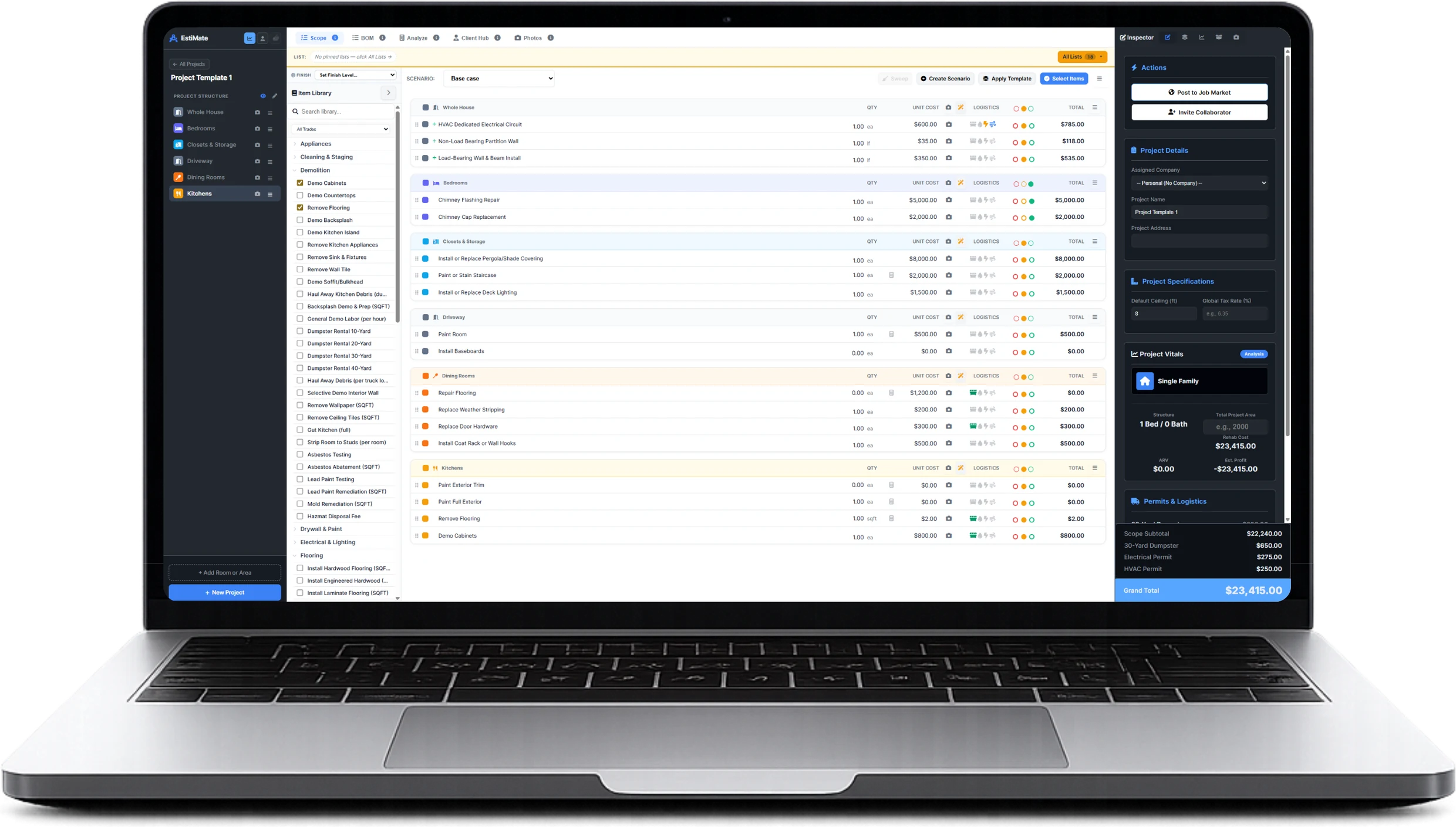
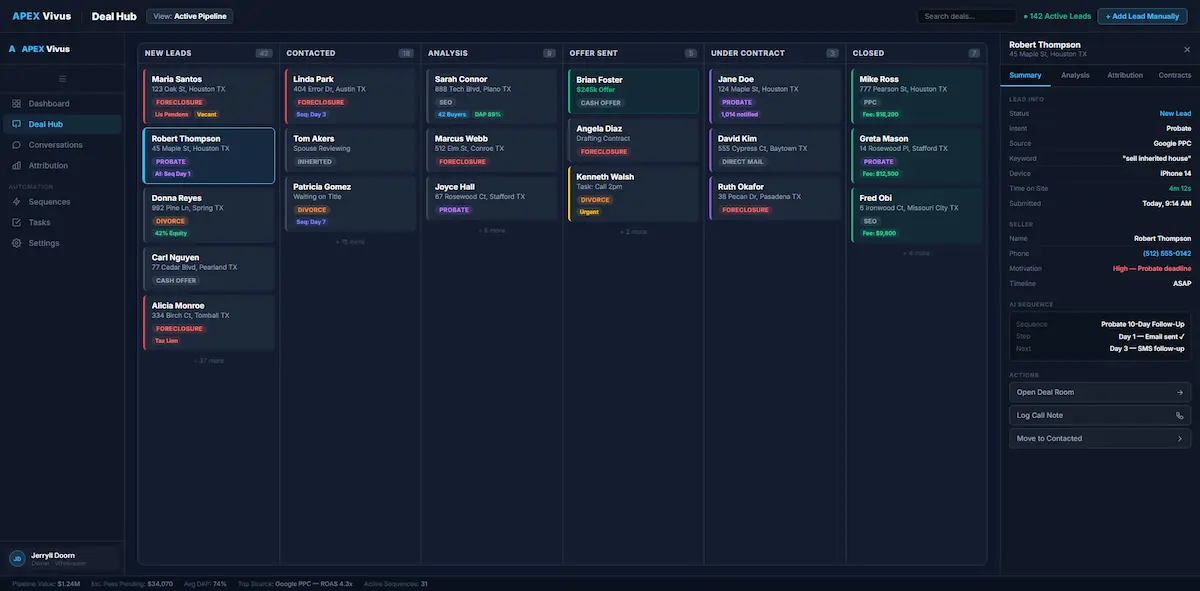
What are the stages of a wholesale deal pipeline, and the rule for each?
The most important column below is "Leave when": a lead moves only when something specific has happened, never because it "feels warm". The last column is how long a lead may sit in a stage before it needs attention.
What "qualified" really means
Most pipelines fail at stage three, because "qualified" is left vague. A seller is qualified when you know five things: why they are selling (the situation), when they need it done (the timeline), the condition of the house, the price they hope for, and that you are talking to everyone who must sign (every owner on the deed, the executor, a spouse). Without the last one, you can do everything right and lose the deal at the closing table.
Where do sellers who are not ready, or never will be, go?
Follow-up (also called nurture or long-term) is for sellers who might sell, but not now. It is not a graveyard: in many wholesale businesses it is where most deals eventually come from. Every lead in it carries the reason it is waiting and the date to reach out again ("tenant leaves in March", "probate hearing June 4").
Dead is for leads that will never sell to you: the house sold, the number is wrong, they asked you to stop contacting them. Always record the reason, and honor every do-not-contact request immediately and permanently; it is the law, and it is decency. Dead leads with reasons are data: if 40% of one list is "wrong number", that list or that skip trace is the problem.
Needs you today
Follow-up lane · this week
Humphrey: Tom has been in Contacted for 8 days and never told us his timeline. I drafted a short text asking when he would ideally like to be done; want me to send it? He gave texting consent on the form.
How often should you follow up with motivated sellers?
Follow up the same day, then on days 1, 3, 7, 14 and 30, then monthly for a year and every two to three months after, mixing calls, emails and texts (texts only with the seller's consent), and stop the moment a seller asks you to.
| When | How | What to say |
|---|---|---|
| Minute 0 to 5 | Call | Thank them, ask what is going on with the house, and what would make this easy for them. |
| Day 1 | Call, then email | If no answer: a short email with your name, photo and a link to how you work. |
| Day 3 | Call, text if they consented | "Just checking you got my email, happy to answer any questions." |
| Day 7 | Call | Something useful: what houses like theirs sold for, or the options they have (list, repair, sell as is). |
| Day 14 and 30 | Email and call | A light check-in; no pressure. |
| Monthly, year 1 | Email, call every other month | Market changes, a seasonal note, one question about their plans. |
| Every 2 to 3 months after | Stay remembered; many sellers come back after 6 to 18 months. |
Two rules keep follow-up from turning into harassment. First, consent and do-not-call: text and auto-dialed or prerecorded calls need the seller's consent, and numbers on do-not-call lists are off limits for cold calls; the TCPA allows $500 to $1,500 per violation. Second, be useful: a follow-up that teaches the seller something about their options builds trust; "are you ready to sell yet?" every week burns it. In Apex Vivus, sequences pause the moment a seller replies, check every number before it is texted or called, and Humphrey drafts the next message from what the seller actually told you, for you to approve.
Which numbers tell you where your pipeline leaks?
Track these per lead source (each list, each mail campaign, your website, each ad), because the averages hide the truth. Here is a worked month for one source, so you can see how the numbers connect:
| Stage | Leads | Rate from the step before | What a low rate usually means |
|---|---|---|---|
| New leads | 400 | — | — |
| Contacted | 160 | 40% | Bad numbers, slow response, or calling at the wrong times |
| Qualified | 48 | 30% | A weak list, or conversations that do not find the situation |
| Appointment set | 20 | 42% | Not asking for the walkthrough on the call |
| Offer made | 16 | 80% | Walkthroughs without a decision-maker present |
| Under contract | 5 | 31% | Offers too low, or follow-up after the offer stops too soon |
| Closed | 4 | 80% | Buyers backing out: numbers off, or too few buyers |
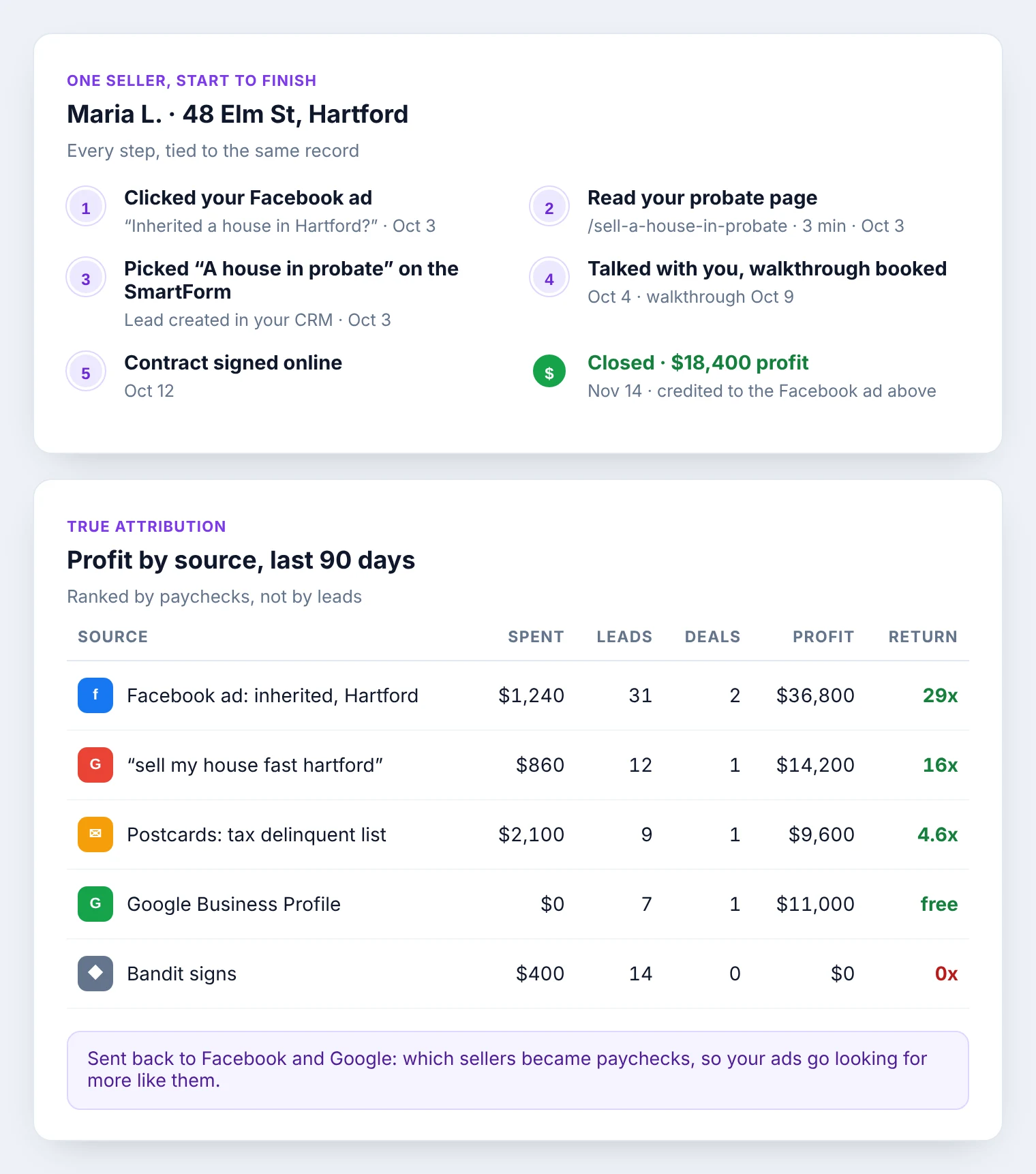
If that source cost $6,000 that month, the cost per lead is $15, the cost per contract is $1,200, and the cost per closed deal is $1,500. With an average fee of $12,000, it returned $48,000 on $6,000. Another source with cheaper leads but no closed deals is the more expensive one. Also watch days in stage: leads that sit too long in Contacted or Offer made are where money quietly disappears. True Attribution in Apex Vivus follows each seller from the ad, letter or page that brought them to the fee at closing, so this table builds itself.
How do you set up a wholesale pipeline, in seven steps?
Create the nine stages and two side lanes
Use exactly the stages above, in a CRM or a spreadsheet. Resist adding more: every extra stage is another place a lead can sit unnoticed.
Write the entry and exit rule for each stage
Copy the "Enter when" and "Leave when" columns and adjust them to how you work. Share them with everyone who touches leads, so "qualified" means the same thing to all of you.
Record the source on every lead
The list, the mail campaign, the ad, the website page. Without it you will never know what made money. Make it a required field.
Give every lead a next action and a date
Not "follow up": "Call Tuesday to ask if the executor signed." A lead with no next action is a lead you have already lost.
Each morning, work only the leads whose next action is today or overdue. That list is your whole job.Set the follow-up schedule
Turn the schedule above into sequences: messages that go out on their own unless the seller replies, with consent checked before any text.
Track the numbers per source
Weekly: leads, contacts, appointments, offers, contracts, closings, cost and fees for each source.
Review the pipeline every week
30 minutes, same day each week, described next.
What should a weekly pipeline review cover?
- Every lead over its time limit in a stage: decide its next action now, or move it to follow-up or dead with a reason.
- Every offer made: who followed up, what the seller said, what would get it signed.
- Every contract: days left on the contract, disclosures signed, cancellation windows, buyers contacted, deposit received.
- The follow-up lane: whose date is this week, and what changed for them.
- The numbers by source: which source made money this month, which only made leads.
- One fix: the single biggest leak, and one change to try this week.
How do you run a wholesale pipeline in a spreadsheet?
One row per lead, these columns, sorted by "Next action date" every morning. It works well up to about 30 to 50 active sellers; past that, a CRM's reminders and automatic follow-up start to pay for themselves.
| Column | Example | Why |
|---|---|---|
| Seller, phone, email | Linda Park, (512) 555-0142 | Who to reach |
| Property | 404 Error Dr, Austin TX | One row per house |
| Source | Probate list, October | What made money |
| Stage | Contacted | Where it is |
| Situation and timeline | Inherited, wants done by March | Why they sell |
| Decision-makers | Linda and her brother | Who must sign |
| Consent to text | Yes, Nov 9, web form | The law |
| Last contact | Nov 26, call | When |
| Next action | Call to ask if her brother agreed | What |
| Next action date | Dec 2 | When, sorted daily |
| Offer, contract price, fee | — | The money |
Which pipeline mistakes lose wholesale deals?
Feelings are not stages. A lead moves when something specific happens.
Every lead without a dated next step is a lead someone else will buy.
Most sellers need many contacts. Move them to follow-up; never just stop.
Then you cannot tell the profitable list from the expensive one.
Fifteen columns means nobody looks at half of them.
Start marketing to buyers the day the seller signs. A solid contract finds a buyer, but only if buyers see it in time: here is how.
Wholesale pipeline questions, answered.
What is a wholesale deal pipeline?
A wholesale deal pipeline is the ordered set of stages every seller lead moves through, from the first contact to a closed deal: new lead, contacted, qualified, appointment set, offer made, under contract, marketing to buyers, assigned and closed. Each stage has a rule for entering it, a rule for leaving it and a next action, so no lead is ever forgotten.
What stages should a wholesaling CRM have?
A wholesaling CRM should have nine working stages (new lead, contacted, qualified, appointment set, offer made, under contract, marketing to buyers, assigned, closed) plus two side lanes: follow-up, for sellers who are not ready yet, and dead, for leads that will never sell, each with a reason.
How often should I follow up with motivated sellers?
A common follow-up rhythm is the same day, then day 1, 3, 7, 14 and 30, then every month for a year, mixing calls, texts (only with consent) and emails, and moving to every two or three months after that. Stop immediately when a seller asks you to.
What KPIs should a wholesaler track?
A wholesaler should track, per lead source: contact rate, appointment rate, offer rate, contract rate, cancellation rate, days in each stage, cost per lead, cost per contract, average assignment fee and profit per source. Cost per contract and profit per source matter most.
Can I run a wholesale pipeline in a spreadsheet?
Yes, you can run a wholesale pipeline in a spreadsheet with one row per lead and columns for stage, source, situation, last contact, next action and next action date. It works until you have about 30 to 50 active sellers; after that, reminders and automatic follow-up in a CRM stop leads from slipping.
How fast should I respond to a new seller lead?
Respond to an inbound seller lead within five minutes if you can. A seller who filled in a form or called is often contacting several companies at once, and the first one to have a real conversation usually gets the appointment.
Do it for real, step by step, in the free wholesaling course.
The Ethical Wholesaling Course walks you through it as part of your first deal, one lesson and one task a day for 30 days, with Humphrey in every lesson as a mentor who knows where you are. It is completely free, and it does not leave the hard parts to you.
You do not have to buy anything. The course is taught inside Apex Vivus, but you can do every lesson with your own website, your own CRM, your own deal analyzer and your own lead sources.
Start the free course →- Free cash buyersready on day one, by market and buy box
- A free deal marketplaceyour contract goes to every buyer it fits
- Free Calculizersthey do the math and flag what is wrong
- A free communitywholesalers, buyers, lenders and agents
The free tools that do this, at $0.
A pipeline is only as full as what you put in it. These free tools fill the top (Driving 4 Deals), price what comes in (the calculators) and move contracts out (the repository and the buyer network).
- The free Ethical Wholesaling Course →The Ethical Wholesaling Course is a free 30-day course that takes you to your first wholesale deal one lesson and one task a day, and comes with free cash buyers, a free deal marketplace, free Calculizers and a free community.
- Driving 4 Deals →Driving 4 Deals is "driving for dollars" on your phone: you drive a neighborhood, tap the houses that look neglected, and the app saves the address, the photo and the route.
- Wholesaling community →The REILink wholesaling community is a free group of wholesalers, cash buyers, lenders and agents where you ask questions, share deals and learn from people a few deals ahead of you.
- Wholesale Calculizer →The Wholesale Calculizer is a free wholesale deal calculator: enter the after repair value and the repairs, and it gives your maximum allowable offer and your assignment fee.
- Post your contract free →The REILink Property Repository is a free marketplace where you post a property you have under contract as a full deal page, and matched cash buyers see it.
- Free cash buyers network →The cash buyers network is a free network where cash buyers save their buy box once (area, price, condition) and get matching deals, so a wholesaler's contract reaches the right buyers.
- Calculizer: six strategies at once →Calculizer is a free real estate investment calculator that runs one property as a flip, a rental, a short-term rental, a BRRRR, a wholesale deal and a house hack, side by side.
Weighing your options? See them side by side.
Honest, scored comparisons of the systems wholesalers move between, the good and the bad of each. And if you would rather ask than read, Humphrey answers out loud.
- Best Carrot alternativesEvery Carrot alternative scored, the good and the bad.
- The Carrot alternativeWhat you get when you move from Carrot, and what it costs.
- Apex Vivus vs CarrotFeature by feature, price by price.
- Best REsimpli alternativesThe CRMs wholesalers move to, scored on one standard.
- The REsimpli alternativeEverything REsimpli does, plus the website and the follow-up.
- Apex Vivus vs REsimpliSide by side, yearly price with yearly price.
- Apex Vivus vs REI BlackBookWhere each one is stronger.
- Apex Vivus vs GoHighLevelBuilt for investors vs built for agencies.
The rest of the wholesaling guide, in plain words.
The other software guides, in plain words.
- Best real estate investing softwareThe whole investor stack, what to look for and how to choose.
- Best rehab estimating softwareEstimating repairs before you make an offer.
- Best real estate deal analysis softwareAnalyzers compared, and the inputs that make a bad deal look good.
- Best software for finding cash buyersBuyer lists that buy, compared.
- Best CRM for real estate investorsInvestor CRMs scored on one standard.
- Best motivated seller softwareTools for finding sellers, and why lists alone fail.
- Best real estate offer softwareMaking offers sellers accept and buyers pay.
- MAO calculatorYour maximum allowable offer, with the formula shown.
- Assignment fee calculator (MaxFee)The highest fee your buyers will still pay.
- Best house flipping softwareRunning a flip from offer to sale.
- Best real estate disposition softwareSelling contracts to buyers who close.
- Best real estate investor website buildersEvery builder compared.
- Best real estate comps softwareComps tools compared, and what they miss.
- ARV calculatorAfter repair value from your comps, adjusted.
- Best real estate lead generation softwareWhere seller leads really come from.
- Best real estate follow-up softwareFollow-up that runs without you.
- Best SEO software for real estate investorsRanking for sellers, compared.
- Real estate marketing attribution softwareWhich marketing brought which deal.
- AI software for real estate investorsWhat AI really does today, and what it cannot.
- Property data software for real estate investorsData tools compared, and how fresh their data is.
- Real estate investor contract softwareContracts, e-signature and deadlines.
- Real estate investor lead capture softwareForms that turn visitors into sellers who call.
- Best real estate agent softwareFor agents who work with investors and sellers.
- Best CRM for real estate agentsAgent CRMs compared.
Ready to run every step of the deal in one system?
Find sellers, reach them first, price the repairs, make an offer backed by what cash buyers really pay, sign the contract and get paid, in Apex Vivus, for $97 a month for your whole team. Moving from another system is free.
Hi, I'm 
Organizing your pipeline? Let me walk you through it.
Can't hear me? Make sure your speakers are on