How to analyze a wholesale deal: ARV, repairs, MAO and your fee, worked on a real example.
Updated · About 25 minutes to read, one hour to do on your first deal
To analyze a wholesale deal, you work backward from the cash buyer: estimate what the house will be worth after repairs (the ARV), subtract the repairs, the buyer's costs and the profit they need, and you have the most a buyer will pay you. Subtract your fee and you have your maximum allowable offer to the seller. Then you check that number against what cash buyers have actually paid nearby, and test whether it survives a lower value or higher repairs.
This guide takes one real-looking house through all nine steps, with every number shown, every word defined the first time it appears, and a calculator at the end that does the same math for your deal (or use the free Wholesale Calculizer). You do not need any experience to follow it.
Why do you analyze a wholesale deal backward, from the buyer?
A wholesale deal analysis is the math that tells you the highest price you can agree to with a seller so that a cash buyer will still take your contract at a profit, and you are still paid a fee. It starts from the buyer, because the buyer, not the seller, decides whether the deal closes.
New wholesalers usually start from the seller: "she wants $150,000, can I make that work?" That is the wrong end. A wholesale deal is only real if a cash buyer (an investor who buys houses without a bank loan, repairs them and resells or rents them) will step into your contract. That buyer has a budget set by arithmetic: what the house will sell for once fixed, minus what it costs to fix, hold and sell it, minus the profit that makes the risk worth it. Whatever is left is the most they will pay. Your fee and the seller's price both have to fit inside that number.
So the order is always: value after repairs → repairs → the buyer's costs → the buyer's profit → the buyer's price → your fee → your offer to the seller. Get any one of those wrong and you either lose the seller to someone who offered more, or sign a contract no buyer will take, which is worse.
The house we will analyze
A 3-bedroom, 2-bathroom ranch, 1,450 square feet, built in 1978, with a one-car garage, in a neighborhood of similar houses. The owner inherited it. The roof is at the end of its life, the kitchen and bathrooms are original, the carpet is stained and the furnace is 24 years old. The house is structurally sound. We will carry these numbers through every step.
How do you analyze a wholesale deal, step by step?
Gather the facts about the house
Before any math, write down what you know, because every later number depends on it: the address, bedrooms, bathrooms, square footage (from the county records, then measured), year built, lot size, garage, basement, and the condition of the five big items: roof, foundation, electrical, plumbing and heating/cooling (HVAC). Also write down the seller's situation and timeline: they decide how flexible the price and closing date can be.
- Our house: 3 bed, 2 bath, 1,450 sq ft, 1978, one-car garage, no basement.
- Big items: roof worn out, furnace 24 years old; foundation, wiring and plumbing fine.
- Seller: inherited, lives out of state, wants it done within 45 days.
Take at least 60 photos on the walkthrough: every room from two corners, every ceiling stain, the roof from the street, the furnace label, the electrical panel. Photos let a buyer, a contractor or a repair estimating tool check your work without another visit.Pull the comps
Comps (comparable sales) are houses that recently sold near yours and are similar enough to show what yours is worth. For a wholesale deal you need renovated comps, because the buyer will renovate. The standard: sold (not listed) in the last 3 to 6 months, within about half a mile (in the same subdivision if possible, never across a major road or school boundary), within 15% of the square footage, same bedroom and bathroom count, similar age and style.
Comp Sold Distance Size Difference Sold for Adjusted A · 3/2 ranch, renovated 2 months ago 0.2 mi 1,410 sq ft No garage (−) $249,000 $256,000 B · 3/2 ranch, renovated 3 months ago 0.3 mi 1,500 sq ft Same, slightly bigger $262,000 $258,000 C · 3/2 ranch, renovated 4 months ago 0.4 mi 1,480 sq ft Two-car garage (+) $268,000 $261,000 D · 3/2 ranch, renovated 5 months ago 0.5 mi 1,430 sq ft Smaller lot $255,000 $257,000 Adjusting means changing a comp's price to what it would have sold for if it were exactly like your house: subtract value for something the comp has that yours does not (comp C's second garage bay), add for something yours has that it lacks (comp A has no garage). Local agents and appraisers can tell you what a garage bay or an extra bathroom is worth in your market.
Do not use the highest sale in the neighborhood, a house that sold to a relative, or a listing that has not sold. Buyers check comps, and one inflated comp is the most common reason a wholesale deal dies.Work out the ARV
The ARV, after repair value, is what the house will sell for once it is renovated to the standard of the comps. Take the range your adjusted comps cluster in and pick a value inside it, toward the middle, not the top. Our adjusted comps run from $256,000 to $261,000, so we use an ARV of $258,000.
If your comps are spread wide (say $230,000 to $290,000), you do not have an ARV yet: you have a guess. Find better comps or narrow the radius before going on.
Estimate the repairs
The repair estimate is what it costs the buyer to bring this house up to the comps: not your dream renovation, the one that makes it sell for the ARV. Price it room by room, at local rates, and never forget the items buyers always count: permits, dumpsters, and a contingency (money set aside for what you cannot see, usually 10% to 15%).
Item What and why Cost Roof Tear off and replace, 1,700 sq ft of roof $11,500 Kitchen Cabinets, counters, sink, appliances, lighting $18,000 Bathrooms Refresh both: vanity, toilet, tile, fixtures $7,500 Paint Whole interior, trim and doors $6,800 Flooring Luxury vinyl plank throughout, 1,450 sq ft $8,200 HVAC New furnace and AC condenser $6,500 Permits Roof, mechanical, building $1,200 Dumpsters Two 20-yard dumpsters $1,400 Contingency 10% of the above, for what the walls hide $6,110 Repair estimate (rounded) $67,200 In Apex Vivus, EstiMate does this from your walkthrough photos: it finds each item in the pictures, prices it at your own (or your area's) rates, and adds the permits, the dumpsters and the consumables most first-time estimates forget, so the estimate a buyer sees is itemized and checkable.
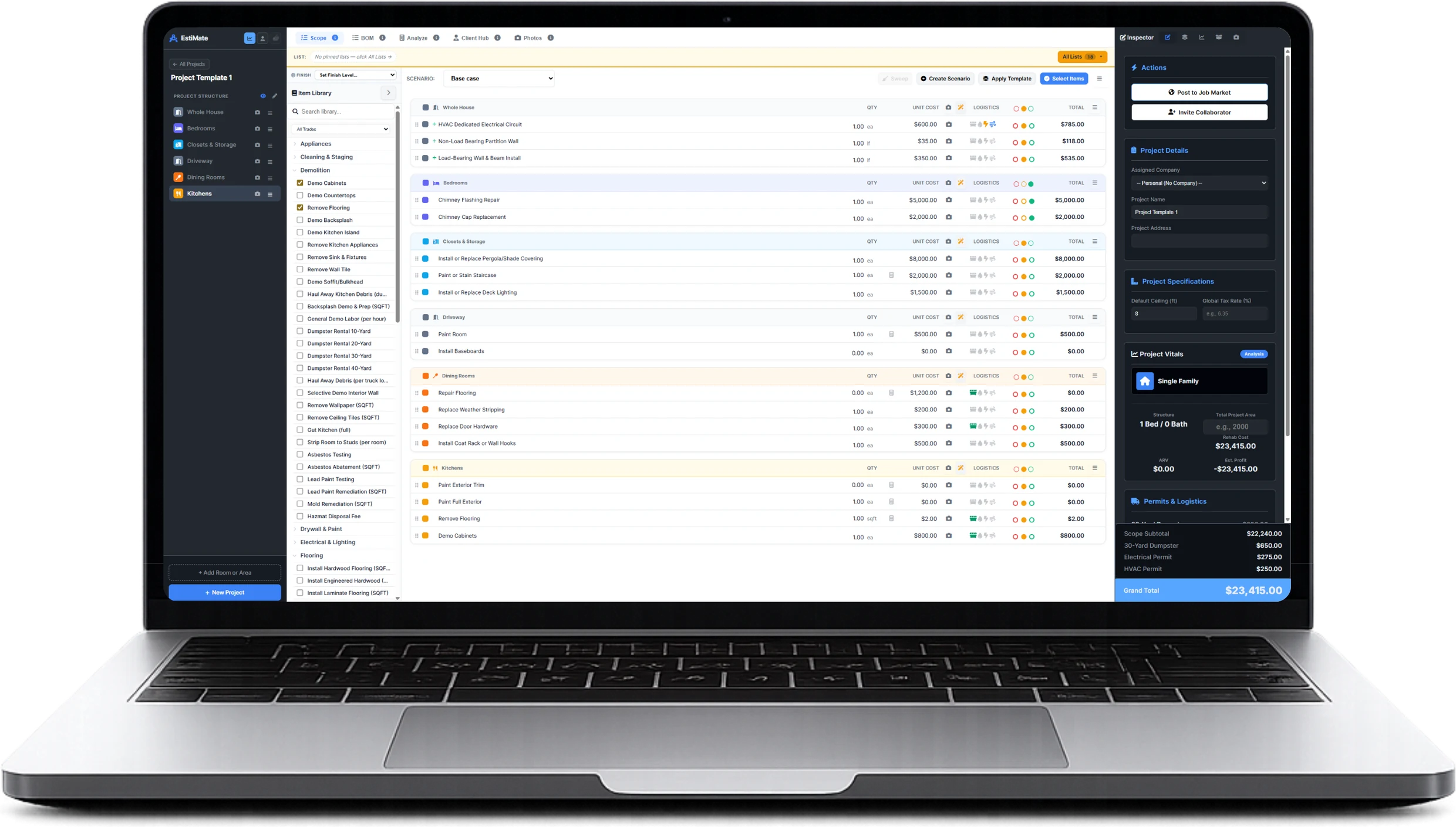
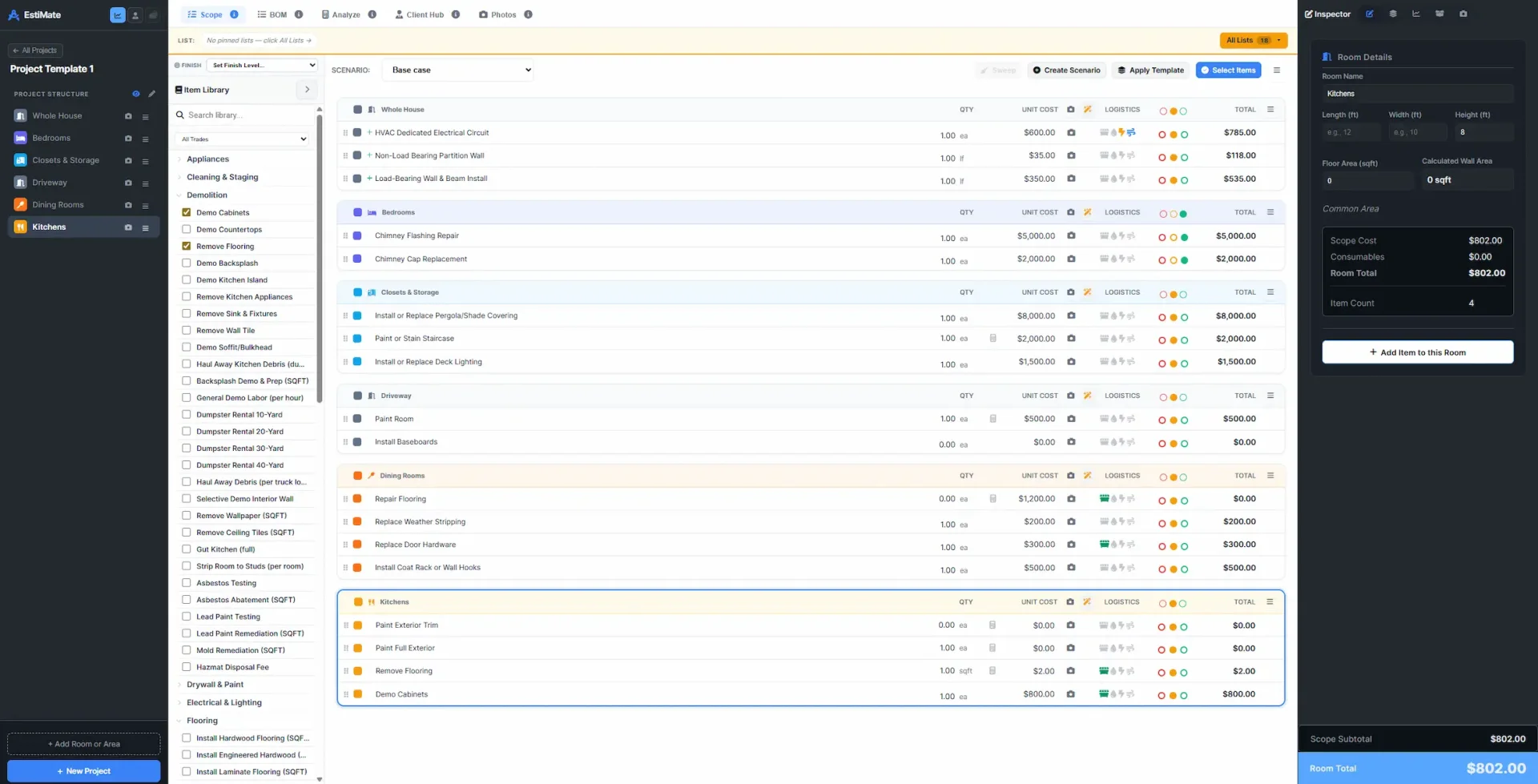
EstiMate turns each walkthrough photo into priced line items, permits and dumpsters included. Add the buyer's costs
A cash buyer pays far more than the purchase price and the repairs. Leave any of these out and your number will look better than any real buyer's:
- Buying costs, about 1% to 2% of the price: title, recording, their attorney. We use 1.5%.
- Holding costs for every month they own it: property taxes, insurance, utilities, the interest on their money or loan. Our house needs about 4 months to renovate and sell, at roughly $2,400 a month: $9,600.
- Selling costs when they resell: the agents' commissions, closing costs, and anything they give the next buyer. We use 8% of the ARV: $20,640.
Set the buyer's profit
The buyer's profit is what makes the risk worth it to them. Most fix-and-flip buyers want at least 10% to 15% of the ARV, or a fixed amount such as $30,000 to $40,000 on a house this size, after every cost. Landlords who will rent the house out judge it by rent instead, which is why knowing who your buyers are (step 9) matters. We use $35,000, about 13.6% of the ARV.
Find the most a buyer will pay
Now subtract everything from the ARV. Because the buying costs are a percentage of the price itself, the last step divides by 1.015:
ARV $258,000 − Repairs $67,200 − Holding costs (4 months) $9,600 − Selling costs (8% of ARV) $20,640 − Buyer's profit $35,000 = What is left for the purchase and its buying costs $125,560 Most a buyer will pay ($125,560 ÷ 1.015) $123,700 Subtract your fee to get your MAO
DefinitionThe maximum allowable offer (MAO) is the highest price you can agree to with the seller: what a buyer will pay you, minus your assignment fee.
If you want a $12,000 fee: $123,700 − $12,000 = $111,700. That is your MAO: the ceiling, never the opening number. You open lower, because the seller will negotiate, and you stop at $111,700. If the seller needs more, you either take a smaller fee, find a buyer who pays more (step 9), or walk away.
Compare it with the 70% rule. The rule says a buyer pays at most 70% of ARV minus repairs: 0.70 × $258,000 − $67,200 = $113,400, about $10,000 less than the $123,700 the full math gives here. If you priced with the rule, your MAO would be $101,400 and you might lose this seller to someone who did the real math. In a market with thin margins, the rule can be wrong in the other direction. That is why the next step exists.
Check it against real buyers, and stress-test it
Everything so far is your opinion of what a buyer should pay. The truth is what cash buyers have paid. Look up the cash purchases of similar, unrenovated houses within a mile in the last 6 to 12 months (county deed records show sales with no mortgage recorded; investor-owned LLCs are a strong sign). If buyers paid $118,000 to $126,000 for houses like ours, our $123,700 is right where the market is. If they paid $100,000, our math is optimistic and we should find out why.
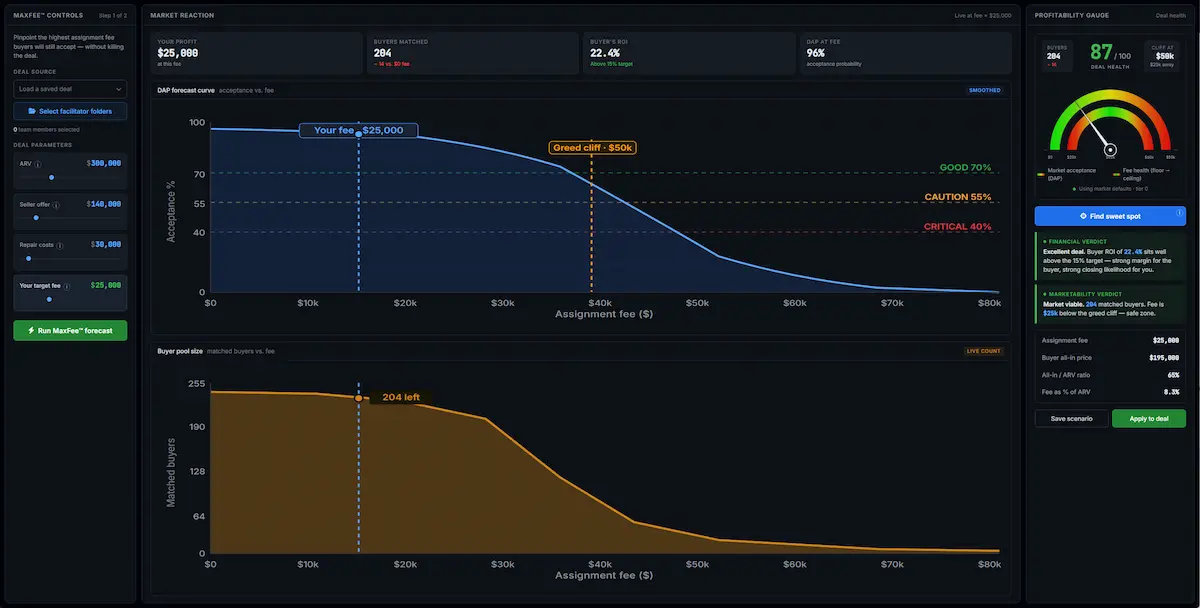
This is exactly what OfferAid in Apex Vivus does: it reads what cash buyers actually paid around the house and works the offer back from that, and MaxFee finds the highest fee those buyers will still pay. Buyer Match shows you the buyers by name, with what they bought.
Then stress-test: what if the ARV is 5% lower, or the repairs 20% higher? If a small miss wipes out the buyer's profit, the deal is fragile and buyers will see it. The calculator below shows all four combinations for your numbers.
Your opening offer: the seller has a 45-day timeline and an inherited house she will never see, so a fair, fast, as-is offer works. Open around $98,000 to $102,000, explain how you got there (the roof, the kitchen, the buyer's costs), and leave yourself room to $111,700. One honest warning from the calculator below: if the ARV came in 5% lower and the repairs 20% higher, the MAO would drop to about $86,800. So before you go above about $100,000, have a roofer and an HVAC contractor confirm those two numbers.
Wholesale deal calculator: your MAO in one minute.
Type your numbers; everything updates as you type. The example house is filled in.
| If the ARV is… | and repairs as estimated | and repairs 20% higher |
|---|
The table shows your MAO in each case at the same fee and buyer profit. If the bottom-right number is far below what you plan to offer, the deal is fragile.
Which deal analysis mistakes kill wholesale deals?
A house listed at $290,000 is a hope, not a value. Use sold prices only.
The buyer is pricing a finished house. Mixing in unrenovated sales drags the ARV down and confuses the buyer.
Holding and selling costs on our house are $30,240. Leave them out and your "great deal" is $30,000 too expensive.
Walls hide rot, old wiring and leaks. Buyers always add a cushion; if you do not, your number looks dishonest to them.
"I want $20,000" does not make it so. The buyers set the ceiling; your fee is what is left after their profit.
The MAO is where you stop, not where you start. Open lower and explain your numbers.
Signing first and doing the math later leads to the "retrade": asking the seller for a lower price. It loses deals and trust.
A flipper and a landlord value the same house differently, and their past purchases show it. Price a solid contract from real buyer data.
If 5% off the ARV erases the buyer's profit, the deal will not survive their inspection.
The wholesale deal analysis checklist.
- House facts written down: beds, baths, square footage, year, lot, garage, the five big items, the seller's timeline.
- 60+ photos from the walkthrough, every room, the roof, the furnace label, the panel.
- 3 to 6 renovated comps, sold in the last 3 to 6 months, within half a mile, adjusted for differences.
- ARV chosen inside the comps' range, toward the middle.
- Itemized repairs with permits, dumpsters and a 10% to 15% contingency.
- Buyer's costs: buying 1% to 2%, holding per month, selling about 8% of ARV.
- Buyer's profit of at least 10% to 15% of ARV, or what your buyers say they need.
- MAO = what a buyer will pay − your fee, written down before you talk price.
- Checked against real cash purchases nearby in the last 6 to 12 months.
- Stress-tested: ARV −5% and repairs +20% still leave the buyer a profit.
- Opening offer below the MAO, with the reasons you will explain to the seller.
Can software analyze a wholesale deal for you?
Software can do the slow parts, and should: pull the comps, price the repairs, apply your costs and show the result. What it cannot do is decide whether a comp is truly comparable or whether that crack is cosmetic; that judgment stays yours. The best tools show their work, so you and your buyer can check every number.
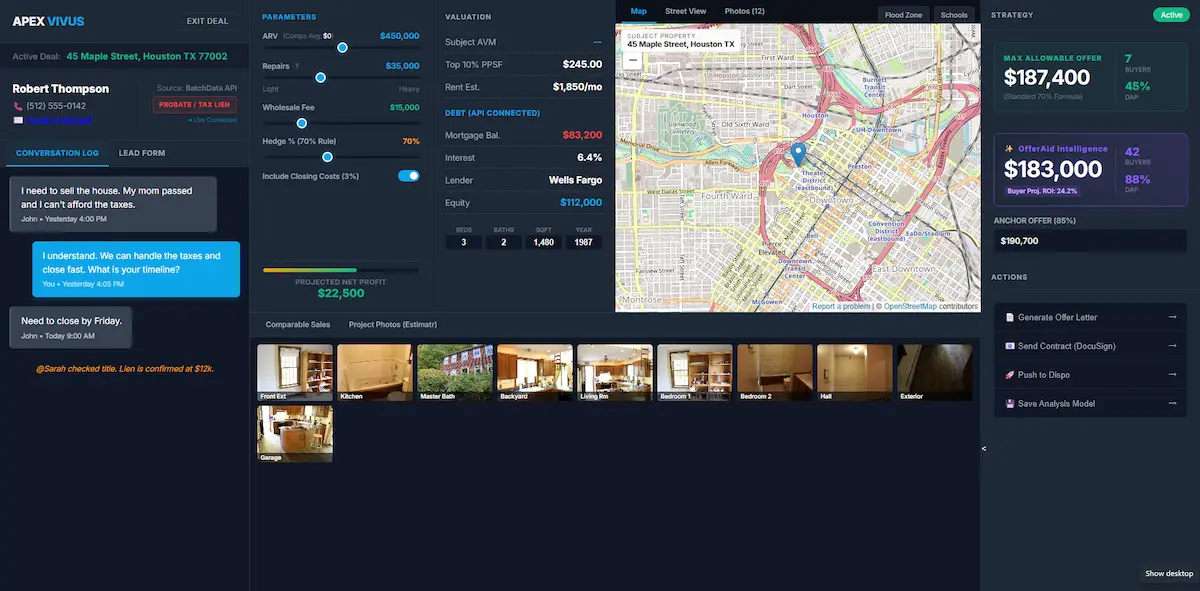
In Apex Vivus the whole analysis lives on the lead's record: the Deal Room pulls and adjusts the comps, EstiMate prices the repairs from your photos, OfferAid works the offer back from what cash buyers paid nearby, MaxFee sets your fee, and the seller can see the numbers in their Home Sale Forecast. For how the other tools compare, read the best real estate wholesaling software in 2026.
Wholesale deal analysis, questions answered.
How do you analyze a wholesale deal?
You analyze a wholesale deal by working backward from what a cash buyer will pay: estimate the after repair value (ARV) from comps, estimate the repairs, subtract the buyer's holding, buying and selling costs and the profit they need, which gives the most a buyer will pay you; subtract your assignment fee, and what is left is your maximum allowable offer (MAO) to the seller. Then check it against what cash buyers have actually paid nearby.
What is MAO in wholesaling?
MAO, the maximum allowable offer, is the most a wholesaler can agree to pay the seller and still leave room for the cash buyer's costs and profit and the wholesaler's own fee. It is a ceiling, not an opening offer: you open lower and stop at the MAO.
What is the 70% rule in wholesaling?
The 70% rule says an investor should pay no more than 70% of the after repair value minus the repairs. On a $258,000 ARV with $67,200 of repairs that is $113,400. It is a quick filter, not a price: in some markets cash buyers pay 75% to 80%, in others 65%, and a wholesaler must still subtract the fee.
How do I calculate ARV for a wholesale deal?
Find three to six renovated houses that sold in the last three to six months within about half a mile, similar in size, bedrooms, bathrooms, age and style; adjust each for differences (a garage, an extra bathroom, a bigger lot); and take the value the adjusted sales cluster around. Use sold prices, not listing prices.
How much should my assignment fee be?
Your assignment fee should be what is left between the seller's price and what cash buyers will actually pay, after you leave the buyer a fair profit. On most single-family deals that is $5,000 to $20,000, but the buyers decide the ceiling, not a round number you like.
How do I estimate repairs if I am not a contractor?
Walk the house room by room with a checklist, photograph everything, price each item at local rates (or from a repair estimating tool that uses your area's costs), add permits, dumpsters and a 10% to 15% contingency, and have a contractor or your most experienced buyer check the big items: roof, foundation, electrical, plumbing and HVAC.
What is a good wholesale deal?
A good wholesale deal is one a cash buyer will close on at a price that pays you a fee: the seller's price is at or below your MAO, the buyer's profit is at least 10% to 15% of ARV after every cost, and the numbers still work if the ARV is 5% lower or the repairs 20% higher.
Do it for real, step by step, in the free wholesaling course.
The Ethical Wholesaling Course walks you through it as part of your first deal, one lesson and one task a day for 30 days, with Humphrey in every lesson as a mentor who knows where you are. It is completely free, and it does not leave the hard parts to you.
You do not have to buy anything. The course is taught inside Apex Vivus, but you can do every lesson with your own website, your own CRM, your own deal analyzer and your own lead sources.
Start the free course →- Free cash buyersready on day one, by market and buy box
- A free deal marketplaceyour contract goes to every buyer it fits
- Free Calculizersthey do the math and flag what is wrong
- A free communitywholesalers, buyers, lenders and agents
The free tools that do this, at $0.
Run this house, or your own, through these free tools. The Wholesale Calculizer does the MAO math from this guide, the Repair Cost Estimator gives a first budget, and MaxFee tells you the fee buyers will still pay.
- The free Ethical Wholesaling Course →The Ethical Wholesaling Course is a free 30-day course that takes you to your first wholesale deal one lesson and one task a day, and comes with free cash buyers, a free deal marketplace, free Calculizers and a free community.
- Wholesale Calculizer →The Wholesale Calculizer is a free wholesale deal calculator: enter the after repair value and the repairs, and it gives your maximum allowable offer and your assignment fee.
- Calculizer: six strategies at once →Calculizer is a free real estate investment calculator that runs one property as a flip, a rental, a short-term rental, a BRRRR, a wholesale deal and a house hack, side by side.
- Repair Cost Estimator →The Repair Cost Estimator is a free tool that gives a quick rehab budget for a house from its size and condition, before you walk it.
- Driving 4 Deals →Driving 4 Deals is "driving for dollars" on your phone: you drive a neighborhood, tap the houses that look neglected, and the app saves the address, the photo and the route.
- Post your contract free →The REILink Property Repository is a free marketplace where you post a property you have under contract as a full deal page, and matched cash buyers see it.
- Wholesaling community →The REILink wholesaling community is a free group of wholesalers, cash buyers, lenders and agents where you ask questions, share deals and learn from people a few deals ahead of you.
Weighing your options? See them side by side.
Honest, scored comparisons of the systems wholesalers move between, the good and the bad of each. And if you would rather ask than read, Humphrey answers out loud.
- Best Carrot alternativesEvery Carrot alternative scored, the good and the bad.
- The Carrot alternativeWhat you get when you move from Carrot, and what it costs.
- Apex Vivus vs CarrotFeature by feature, price by price.
- Best REsimpli alternativesThe CRMs wholesalers move to, scored on one standard.
- The REsimpli alternativeEverything REsimpli does, plus the website and the follow-up.
- Apex Vivus vs REsimpliSide by side, yearly price with yearly price.
- Apex Vivus vs REI BlackBookWhere each one is stronger.
- Apex Vivus vs GoHighLevelBuilt for investors vs built for agencies.
The rest of the wholesaling guide, in plain words.
The other software guides, in plain words.
- Best real estate investing softwareThe whole investor stack, what to look for and how to choose.
- Best rehab estimating softwareEstimating repairs before you make an offer.
- Best real estate deal analysis softwareAnalyzers compared, and the inputs that make a bad deal look good.
- Best software for finding cash buyersBuyer lists that buy, compared.
- Best CRM for real estate investorsInvestor CRMs scored on one standard.
- Best motivated seller softwareTools for finding sellers, and why lists alone fail.
- Best real estate offer softwareMaking offers sellers accept and buyers pay.
- MAO calculatorYour maximum allowable offer, with the formula shown.
- Assignment fee calculator (MaxFee)The highest fee your buyers will still pay.
- Best house flipping softwareRunning a flip from offer to sale.
- Best real estate disposition softwareSelling contracts to buyers who close.
- Best real estate investor website buildersEvery builder compared.
- Best real estate comps softwareComps tools compared, and what they miss.
- ARV calculatorAfter repair value from your comps, adjusted.
- Best real estate lead generation softwareWhere seller leads really come from.
- Best real estate follow-up softwareFollow-up that runs without you.
- Best SEO software for real estate investorsRanking for sellers, compared.
- Real estate marketing attribution softwareWhich marketing brought which deal.
- AI software for real estate investorsWhat AI really does today, and what it cannot.
- Property data software for real estate investorsData tools compared, and how fresh their data is.
- Real estate investor contract softwareContracts, e-signature and deadlines.
- Real estate investor lead capture softwareForms that turn visitors into sellers who call.
- Best real estate agent softwareFor agents who work with investors and sellers.
- Best CRM for real estate agentsAgent CRMs compared.
Ready to run every step of the deal in one system?
Find sellers, reach them first, price the repairs, make an offer backed by what cash buyers really pay, sign the contract and get paid, in Apex Vivus, for $97 a month for your whole team. Moving from another system is free.
Hi, I'm 
Analyzing a wholesale deal? Let me walk you through it.
Can't hear me? Make sure your speakers are on