Do you need to find buyers before you put a house under contract? No. You need a solid contract.
Updated · About 20 minutes to read
No. You do not need a buyer before you put a house under contract. A solid contract always finds a buyer. A solid contract is one signed at a price that leaves a real cash buyer a real profit, with terms that give you time to close. The mistake is not signing before you have a buyer; it is signing at a price no buyer will pay. So the work before you sign is not lining up a buyer: it is learning what cash buyers actually paid for houses like this one, nearby, recently, and pricing your contract from that. Then, the day the seller signs, you find, verify and line up your buyers, as this guide shows.
If you are new: a cash buyer is an investor who buys houses without a bank loan and can close in days. Wholesalers argue endlessly about "buyers first or contract first". The answer is contract first, priced right. Below is how to price it from real buyer data, where to find buyers, how to verify them, and what the law allows.
If a solid contract always finds a buyer, what makes a contract solid?
A solid wholesale contract is a purchase contract signed at a price at or below what real cash buyers pay for similar houses nearby, minus your fee, with an assignment clause, honest disclosure to the seller, and enough time to close. Put a solid contract in front of investors and one of them buys it, because the numbers work for them.
Here is the truth most "find your buyers first" advice misses: buyers do not commit to houses that do not exist yet, and they do not need to. Investors who buy houses for a living buy every good deal they see. If your contract is priced right, you will find a buyer. If it is priced wrong, the longest buyer list in your state will not save it.
The way wholesale deals really die is the price. A wholesaler signs at a number no investor will pay, spends two weeks sending it to everyone, gets no takers, and then asks the seller for a lower price (a "retrade", which destroys the seller's trust) or cancels on a technicality. That seller is often worse off than if you had never called, and a wholesaler with that reputation runs out of sellers, buyers and title companies.
So the only buyer work you do before signing is research: what did cash buyers actually pay for houses like this, near it, recently? That tells you the price of a solid contract. If four investors bought houses like this one within a mile last year for $118,000 to $126,000, you know your ceiling before the seller names a price. Sign at or under it, and the buyer will come.
The house we will use
The same house as in how to analyze a wholesale deal: a 3-bedroom, 2-bathroom 1978 ranch, 1,450 square feet, ARV about $258,000, repairs about $67,200 (roof, kitchen, baths, flooring, furnace), inherited by an owner who lives out of state.
How do you price a solid contract from real buyers, then find the one who takes it?
Choose the area and the kind of house
Buyers buy by area and by type, so your list should too. Write down the zip codes (or neighborhoods) you work, and the kind of house you are about to buy: here, single-family, 3/2, around 1,450 square feet, needs a roof and a kitchen, worth about $258,000 fixed.
Pull who bought with cash in the last 12 months
Your county's recorder or assessor publishes every recorded sale, usually free online. Look for purchases with no mortgage recorded at the same time (a cash or private-money purchase), bought by LLCs, corporations or trusts, or by people who own several houses. Investors who bought unrenovated houses and resold them renovated within months are flippers; those who kept them and now rent them are landlords. Both are buyers.
For our house, the last 12 months within a mile show nine cash purchases of unrenovated houses. Four were 3/2 ranches of similar size: $118,000, $121,000, $124,000 and $126,000.
Your title company and local hard-money lenders see these buyers every week. Ask them who is actively buying in your zip codes; many will introduce you.Find the people behind the companies
"Maple Street Holdings LLC" does not answer phones. Your state's business registry (usually the Secretary of State) lists each company's registered agent and often its members or manager. That name, plus the mailing address on the deed, is the person you need.
Get their phone numbers, carefully
Skip tracing (looking up phone numbers and emails from a name and address, through data companies, at about 10 to 15 cents a match) finds most investors. Investors are business contacts, but the same do-not-call and texting rules apply as for anyone: check every number before you call, and text only with consent. Many investors also list their company's phone on their website or business registration.
Call them and write each buy box
DefinitionA buy box is the exact description of the houses a cash buyer will purchase: where, what type, what price range and condition, the most they pay as a share of value, how fast they close and how they pay.
Call as what you are: a local wholesaler who brings off-market houses to investors. Ask:
- Which zip codes or neighborhoods do you buy in? Anything you avoid?
- What do you buy: single-family, small multifamily, land? Bedrooms, size, age?
- Flip or rent? What rehab level is too much (foundation, fire, full gut)?
- What is your usual purchase price range, and how do you price a deal: a share of ARV, or a rent number?
- How fast can you close, with what money, and with which title company?
- How many houses did you buy this year, and how many do you want next year?
- What is the best way to send you deals, and how fast do you decide?
Do not describe a specific house you have no contract on, its address or a price you will sell it at. Talk about the kind of deals you bring and their buy box. See what the law allows.Verify they are active and can close
A buyer is only as good as their last closing. Check three things for each: recency (a purchase in the public records in the last 6 to 12 months), money (proof of funds: a recent bank statement or a letter from their lender, which serious buyers send without fuss), and reputation (ask their title company, and other wholesalers, whether they closed when they said they would). Interest is not commitment: "send me everything" from someone who has not bought in two years is a name, not a buyer.
Tier your buyers for this deal
Sort them for this house: A-buyers bought houses like it within about a mile in the last 6 months and closed on time; B-buyers buy in the area but a different type or less recently; C-buyers are names you have not verified. For our ranch: three A-buyers (they bought at $121,000 to $126,000), five B-buyers, and a long list of C's.
Set your offer from what they paid
Your A-buyers paid $121,000 to $126,000 for houses like this. Your own analysis said the most a buyer would pay is about $123,700. The two agree, so your maximum allowable offer to the seller (that number minus your fee) is solid: about $111,700 with a $12,000 fee. If the buyer data had said $100,000, you would trust the data, not the spreadsheet.
Sign the solid contract, then send it to your A-buyers first
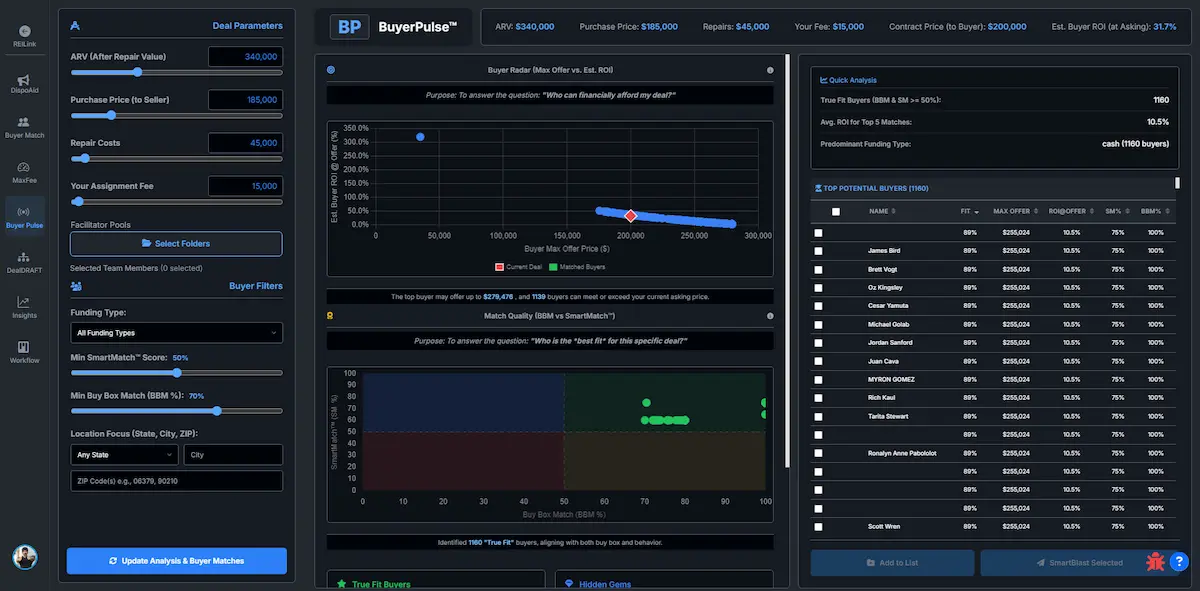
Once the seller signs (and any disclosure your state requires), send the deal to your A-buyers privately and personally, with the photos, the repair estimate and the comps, and a short deadline. If none takes it in 48 hours, go to your B-buyers, then wider. Ask the buyer who takes it for a non-refundable deposit with the title company, and keep a backup buyer warm until closing.
Where can you find cash buyers, besides the deed records?
They close investor deals every week and know who closes on time. Bring them your deals and they will bring you buyers.
Their borrowers are active flippers. Many lenders gladly connect you, because your deals become their loans.
Owners of several rentals buy steadily, often below what flippers need, for houses that rent well.
Real buyers show up in person. Ask what they bought last month, not what they want to buy.
A joint venture splits the fee with a wholesaler who has the buyer. Better half a fee than a cancelled contract.
Agents see cash offers on listed houses; investor-friendly agents know who wrote them.
Bidders at foreclosure and tax sales pay cash and buy distressed houses: exactly your buyers.
Whoever pays for them buys houses. Call them; many are buyers, others are wholesalers to partner with.
Deal marketplaces and investor groups have buyers, but verify each one the same way: recent purchases and proof of funds.
Who bought houses like this within a mile, last 12 months
| Buyer | Bought | Paid | When | Verified | Tier |
|---|---|---|---|---|---|
| Northside Renovations LLC · D. Kim | 3/2 ranch, 0.4 mi | $126,000 | 2 mo | Proof of funds | A |
| Maple Street Holdings LLC · R. Okafor | 3/2 ranch, 0.6 mi | $124,000 | 4 mo | Closed 3 on time | A |
| J. Walsh | 3/2 ranch, 0.9 mi | $121,000 | 5 mo | Lender letter | A |
| Pinewood Rentals LLC | 3/1 bungalow, 0.8 mi | $118,000 | 9 mo | Not yet | B |
Humphrey: Your three A-buyers paid $121,000 to $126,000, so a buyer price of about $123,700 is right in the middle. With your $12,000 fee your ceiling with the seller is about $111,700. I will not send them anything about this house until the contract is signed.
What does the law allow before you have a contract?
Before you have a contract, you can research who buys, talk to investors about their buy boxes and the kind of deals you bring, and use their past purchases to price your offer. Advertising a specific house you have no right to sell, or for pay, can be unlicensed real estate brokerage, and some states restrict marketing even a signed contract.
- Pennsylvania treats a wholesale transaction as broker activity: a license is required (Act 52 of 2024, from January 2025).
- South Carolina requires a license to market property for pay; advertising your contract position is allowed only when the property itself is not marketed.
- Nebraska treats a licensee who markets an equitable interest as the purchaser's agent, with a signed agency disclosure.
- Illinois and Virginia require a broker license once you deal in contracts two or more times in 12 months.
- Oklahoma, Ohio, Missouri, Connecticut, Oregon and others require written disclosures to the seller, some days before signing, and some give the seller a window to cancel.
Those rules come from the statutes summarized by CrowdfundedWealth's 17-state review; laws change, and this is not legal advice. Have a real estate attorney in your state review your contract, your disclosures and how you market. In Apex Vivus each deal carries its state's rules, and Buyer Match will not send a property to buyers before it is under contract.
Which buyer mistakes lose wholesale deals?
Thousands of "cash buyers" who never bought anything near you are noise. Three who did are a business.
Holding off on a good seller until a buyer "commits" loses the seller. Sign the solid contract; the buyer follows.
A buyer with nothing at stake walks easily. Ask for a non-refundable deposit with title when they sign.
Your best buyers stop opening your emails. Send each deal to the buyers it fits, best first.
What buyers paid beats any rule of thumb. See the full analysis.
Advertising a house you have no contract on is how wholesalers end up facing their state's real estate commission.
When your only buyer backs out, you are the one in default with the seller. Always keep a backup.
Finding buyers before contract, questions answered.
Do I need to find a buyer before putting a property under contract?
No. You do not need a buyer before you put a property under contract: a solid contract always finds a buyer. A solid contract is one signed at a price that leaves a real cash buyer a real profit, with terms that let you close. What you do need before signing is to know what cash buyers actually pay for houses like it nearby, so the price you sign is right. Then you find the buyer after you sign.
How do I find cash buyers for wholesaling?
Find cash buyers from who actually bought: county deed records of recent purchases with no mortgage recorded, LLC and company buyers, landlords with several rentals, hard money lenders and title companies who close investor deals, local investor meetups and other wholesalers. Then call them, learn their buy box and verify they are still buying.
What is a buy box?
A buy box is the description of the houses a cash buyer will purchase: the areas or zip codes, property type, price range, size, condition and repair level, the maximum price as a share of value, how fast they close and how they pay. Matching a deal to the buyers whose buy box fits it is the core of dispositions.
How do I verify a cash buyer is real and active?
Verify a cash buyer by checking that they bought recently (the last 6 to 12 months) in your area in the public records, asking for proof of funds such as a recent bank statement or a lender letter, asking which title company they close with, and asking other wholesalers whether they closed on time. A large list of names who never bought is not a buyer list.
Can I market a property before it is under contract?
Generally no: advertising a specific house you have no contract on, or no right to sell, can be treated as unlicensed real estate brokerage, and states such as Pennsylvania, South Carolina and Nebraska restrict even marketing your contract. Before you sign, talk to buyers about the kind of deal you are working on and their buy box, not a specific address. Check your state's law with an attorney.
How many cash buyers do I need?
You need three to five cash buyers who have bought houses like this one, near it, in the last year, not hundreds of names. One buyer is a single point of failure: if they back out the week of closing, you are in default with the seller.
Do it for real, step by step, in the free wholesaling course.
The Ethical Wholesaling Course walks you through it as part of your first deal, one lesson and one task a day for 30 days, with Humphrey in every lesson as a mentor who knows where you are. It is completely free, and it does not leave the hard parts to you.
You do not have to buy anything. The course is taught inside Apex Vivus, but you can do every lesson with your own website, your own CRM, your own deal analyzer and your own lead sources.
Start the free course →- Free cash buyersready on day one, by market and buy box
- A free deal marketplaceyour contract goes to every buyer it fits
- Free Calculizersthey do the math and flag what is wrong
- A free communitywholesalers, buyers, lenders and agents
The free tools that do this, at $0.
Sign the solid contract, then put it where buyers already look. All of these are free: post the contract, reach matched cash buyers, price your fee, and ask the community when you are stuck.
- The free Ethical Wholesaling Course →The Ethical Wholesaling Course is a free 30-day course that takes you to your first wholesale deal one lesson and one task a day, and comes with free cash buyers, a free deal marketplace, free Calculizers and a free community.
- Post your contract free →The REILink Property Repository is a free marketplace where you post a property you have under contract as a full deal page, and matched cash buyers see it.
- Free cash buyers network →The cash buyers network is a free network where cash buyers save their buy box once (area, price, condition) and get matching deals, so a wholesaler's contract reaches the right buyers.
- Wholesaling community →The REILink wholesaling community is a free group of wholesalers, cash buyers, lenders and agents where you ask questions, share deals and learn from people a few deals ahead of you.
- Wholesale Calculizer →The Wholesale Calculizer is a free wholesale deal calculator: enter the after repair value and the repairs, and it gives your maximum allowable offer and your assignment fee.
- Private money lenders network →The private money lenders network is where investors and private lenders meet around real deal pages with the after repair value, the repair scope and the numbers.
- Driving 4 Deals →Driving 4 Deals is "driving for dollars" on your phone: you drive a neighborhood, tap the houses that look neglected, and the app saves the address, the photo and the route.
Weighing your options? See them side by side.
Honest, scored comparisons of the systems wholesalers move between, the good and the bad of each. And if you would rather ask than read, Humphrey answers out loud.
- Best Carrot alternativesEvery Carrot alternative scored, the good and the bad.
- The Carrot alternativeWhat you get when you move from Carrot, and what it costs.
- Apex Vivus vs CarrotFeature by feature, price by price.
- Best REsimpli alternativesThe CRMs wholesalers move to, scored on one standard.
- The REsimpli alternativeEverything REsimpli does, plus the website and the follow-up.
- Apex Vivus vs REsimpliSide by side, yearly price with yearly price.
- Apex Vivus vs REI BlackBookWhere each one is stronger.
- Apex Vivus vs GoHighLevelBuilt for investors vs built for agencies.
The rest of the wholesaling guide, in plain words.
The other software guides, in plain words.
- Best real estate investing softwareThe whole investor stack, what to look for and how to choose.
- Best rehab estimating softwareEstimating repairs before you make an offer.
- Best real estate deal analysis softwareAnalyzers compared, and the inputs that make a bad deal look good.
- Best software for finding cash buyersBuyer lists that buy, compared.
- Best CRM for real estate investorsInvestor CRMs scored on one standard.
- Best motivated seller softwareTools for finding sellers, and why lists alone fail.
- Best real estate offer softwareMaking offers sellers accept and buyers pay.
- MAO calculatorYour maximum allowable offer, with the formula shown.
- Assignment fee calculator (MaxFee)The highest fee your buyers will still pay.
- Best house flipping softwareRunning a flip from offer to sale.
- Best real estate disposition softwareSelling contracts to buyers who close.
- Best real estate investor website buildersEvery builder compared.
- Best real estate comps softwareComps tools compared, and what they miss.
- ARV calculatorAfter repair value from your comps, adjusted.
- Best real estate lead generation softwareWhere seller leads really come from.
- Best real estate follow-up softwareFollow-up that runs without you.
- Best SEO software for real estate investorsRanking for sellers, compared.
- Real estate marketing attribution softwareWhich marketing brought which deal.
- AI software for real estate investorsWhat AI really does today, and what it cannot.
- Property data software for real estate investorsData tools compared, and how fresh their data is.
- Real estate investor contract softwareContracts, e-signature and deadlines.
- Real estate investor lead capture softwareForms that turn visitors into sellers who call.
- Best real estate agent softwareFor agents who work with investors and sellers.
- Best CRM for real estate agentsAgent CRMs compared.
Ready to run every step of the deal in one system?
Find sellers, reach them first, price the repairs, make an offer backed by what cash buyers really pay, sign the contract and get paid, in Apex Vivus, for $97 a month for your whole team. Moving from another system is free.
Hi, I'm 
Looking for buyers before you sign? Let me walk you through it.
Can't hear me? Make sure your speakers are on