How to organize real estate leads: one place, one stage, one next step.
Updated · About 14 minutes to read
To organize real estate leads, put every lead in one place, give each one one stage, one next step with a date, and where it came from. Then start every day by doing the next steps that are due, oldest first. That is the whole system. Everything else (tags, scores, automations) only helps if those four things are true for every single lead. This guide shows how to set it up in a free spreadsheet or a CRM, the morning routine that keeps it working, and the mistakes that quietly lose deals.
If you are new: a lead is a person who might sell you a house. Most deals come from following up for weeks or months, so a lead you cannot find again is a deal you lose.
What does it mean to organize real estate leads?
Organizing real estate leads means keeping every seller lead in one system where each one has a stage (how far along the conversation is), a next step with a date (what you do and when), its source (what brought it in) and its full history (every call, text, email and note), so you always know who to contact today and nobody is forgotten.
- Stage
- A stage is how far along a lead is: New, Contacted, Appointment, Offer Sent, Under Contract, Closed, Follow-up or Dead.Every stage, explained.
- Next step
- The next step is the one thing you will do with this lead, with a date: "call back Thursday", "send offer Friday".A lead without a next step is a lead you have stopped working.
- Source
- The source is what brought the lead in: a mailer, an ad, a page, a list, a referral.It is how you know which marketing to pay for again.
- Duplicate
- A duplicate is the same seller entered twice, often from two sources.Two people then call the same seller, or nobody does.
The spreadsheet layout, if you start free.
Ten columns are enough. Sort by Next date every morning.
| Seller | Property | Phone | Source | Stage | Last contact | Next step | Next date |
|---|---|---|---|---|---|---|---|
| Ren Alvarez | 418 Elm St | (860) 555-0142 | Google search | Offer Sent | Mon | Call: did brother agree? | Today |
| T. Brooks | 92 Birch Rd | (860) 555-0177 | Mailer #3 | Contacted | Last week | Second call, ask timeline | Today |
| M. Ortiz (heir) | 7 Cedar Ct | — | Driving 4 Deals | New | — | Find heirs' phone | Thu |
| D. Kim | 55 Oak Ave | (860) 555-0119 | Facebook ad | Follow-up | 2 months ago | Check in: lease ends in March | Feb 1 |
The other two columns are Notes (their words, dated) and Email. A spreadsheet like this works well up to about 20 or 30 active leads. Past that, or with more than one person calling, the follow-ups start to slip, and that is when a CRM pays for itself. See the best CRMs for real estate investors, scored.
How do you organize real estate leads, step by step?
Choose one place, and only one
A spreadsheet or a CRM, but one. Leads in your phone, your email, a notebook and a sheet are four places, and the lead you need is always in the other one.
If you work with anyone else, it has to be a place they can see too.Bring every lead in, with its source
Go through your phone, texts, email, voicemail and forms and put every seller in. Write where each one came from. If you do not know, write "unknown" and fix that for the next ones.
Remove the duplicates
Search by phone number and by property address. Keep one record per seller per house, with everything merged into it.
Give every lead one stage
Use the same short list of stages for everyone. If you are not sure, it is earlier than you think: a voicemail is "Contacted", not "Talked".
Seller lead stages explained lists each stage and what moves a lead to the next one.
Give every lead one next step and a date
For each lead, decide the next thing you will do and when. Dead leads get a date too: "check back in 6 months". Only a seller who asked you to stop gets no date, and you mark them do-not-contact.
Never leave the next step empty. Empty means forgotten.Keep the history on the lead
After every call, text or visit, add two lines: what they said, and what you agreed. Their words matter: "my brother has to agree" tells you the next step.
Run the morning routine
Every morning: sort by next date, do everything due today and overdue, oldest first, and give each one a new next step. Ten minutes on a slow day, an hour on a busy one. This routine is what makes the system work.
Do it for real, step by step, in the free wholesaling course.
This guide explains how to organize real estate leads. The Ethical Wholesaling Course walks you through it as part of your first deal, one lesson and one task a day for 30 days, with Humphrey in every lesson as a mentor who knows where you are. It is completely free, and it does not leave the hard parts to you.
You do not have to buy anything. The course is taught inside Apex Vivus, but you can do every lesson with your own website, your own CRM, your own deal analyzer and your own lead sources.
Start the free course →- Free cash buyersready on day one, by market and buy box
- A free deal marketplaceyour contract goes to every buyer it fits
- Free Calculizersthey do the math and flag what is wrong
- A free communitywholesalers, buyers, lenders and agents
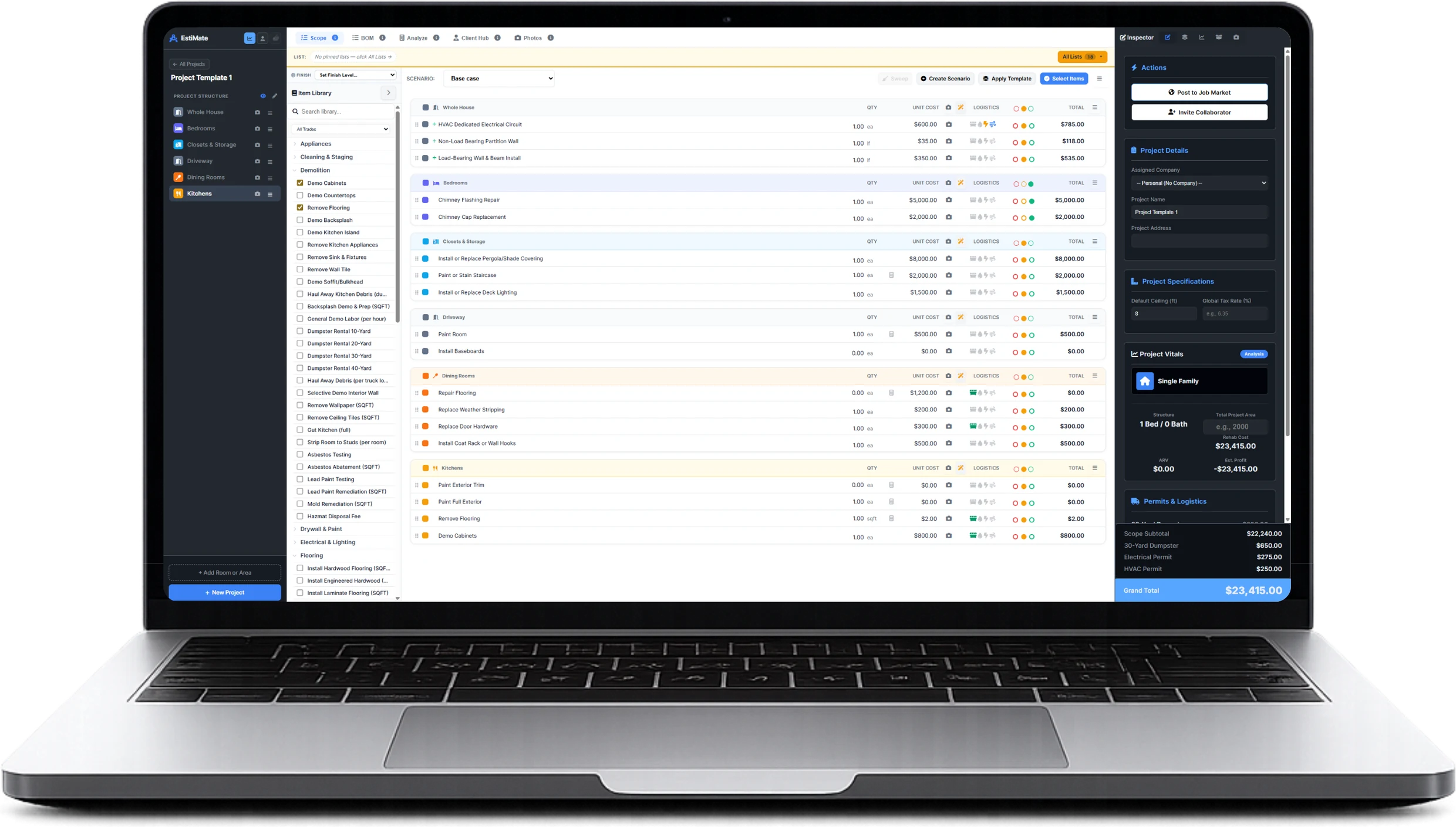
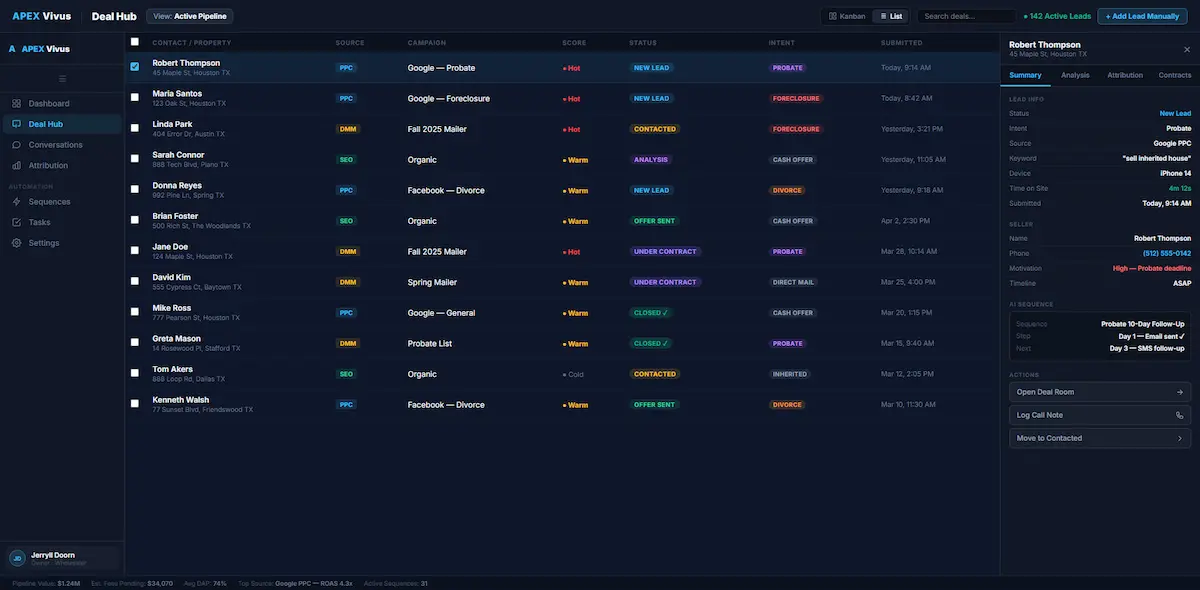
What does a CRM add to an organized lead list?
Forms, calls, texts and ads land in the CRM with their source. Nobody copies anything.
The same phone or address twice is merged, so two people do not call the same seller.
Texts and emails go out on schedule and stop when the seller replies.
Every call, text and email on one timeline per seller.
Due and overdue next steps first, without sorting a sheet.
Every closed deal shows what brought it, and what it cost.
Mistakes to avoid.
A lead in your phone and in the sheet will be updated in one and called from the other.
The lead with no date is the one you never call again.
Mark them Dead with a date to check back. Situations change; sellers who said no often sell a year later.
Twelve stages means nobody agrees where a lead belongs. Eight is plenty.
"Called, interested" tells you nothing next month. "Lease ends March, wants to move near daughter" does.
The system works only if the due list is cleared every day.
Questions, answered.
How do I organize real estate leads?
Put every lead in one place, give each one a stage, a next step with a date and its source, keep every call, text and note on the lead, and every morning do the next steps that are due, oldest first.
What is the best way to keep track of seller leads?
One system everyone on your team uses, a spreadsheet at first and a CRM once you have more than about 20 active leads or more than one person calling. What matters most is that every lead has a next step and a date.
How many stages should a real estate lead pipeline have?
About eight: New, Contacted, Appointment, Offer Sent, Under Contract, Closed, plus Follow-up and Dead as side lanes. More stages make people disagree about where a lead belongs.
Should I delete dead leads?
No. Mark them Dead with the reason and a date to check back. Many sellers who say no today sell a year later, when their situation has changed.
Can I use a spreadsheet to organize real estate leads?
Yes. Ten columns (seller, property, phone, email, source, stage, last contact, next step, next date, notes) sorted by next date every morning work well for your first 20 to 30 leads.
The free tools that help, at $0.
Every one of these is free. Use them before you pay for anything.
- The free Ethical Wholesaling Course →The Ethical Wholesaling Course is a free 30-day course that takes you to your first wholesale deal one lesson and one task a day, and comes with free cash buyers, a free deal marketplace, free Calculizers and a free community.
- Driving 4 Deals →Driving 4 Deals is "driving for dollars" on your phone: you drive a neighborhood, tap the houses that look neglected, and the app saves the address, the photo and the route.
- Wholesaling community →The REILink wholesaling community is a free group of wholesalers, cash buyers, lenders and agents where you ask questions, share deals and learn from people a few deals ahead of you.
- Wholesale Calculizer →The Wholesale Calculizer is a free wholesale deal calculator: enter the after repair value and the repairs, and it gives your maximum allowable offer and your assignment fee.
- Post your contract free →The REILink Property Repository is a free marketplace where you post a property you have under contract as a full deal page, and matched cash buyers see it.
Weighing your options? See them side by side.
Honest, scored comparisons of the systems investors move between, the good and the bad of each. And if you would rather ask than read, Humphrey answers out loud.
- Best Carrot alternativesEvery Carrot alternative scored, the good and the bad.
- The Carrot alternativeWhat you get when you move from Carrot, and what it costs.
- Apex Vivus vs CarrotFeature by feature, price by price.
- Best REsimpli alternativesThe CRMs wholesalers move to, scored on one standard.
- The REsimpli alternativeEverything REsimpli does, plus the website and the follow-up.
- Apex Vivus vs REsimpliSide by side, yearly price with yearly price.
- Apex Vivus vs REI BlackBookWhere each one is stronger.
- Apex Vivus vs GoHighLevelBuilt for investors vs built for agencies.
This guide's companions.
- Best CRM for real estate investorsInvestor CRMs scored on one standard.
- Seller lead stages explainedWhat each stage means and what moves a lead on.
- Why seller leads go coldThe seven reasons, and the fix for each.
The other software guides, in plain words.
- Best real estate investing softwareThe whole investor stack, what to look for and how to choose.
- Best rehab estimating softwareEstimating repairs before you make an offer.
- Best real estate wholesaling software13 tools scored, with prices and the laws software must handle.
- Best real estate deal analysis softwareAnalyzers compared, and the inputs that make a bad deal look good.
- Best software for finding cash buyersBuyer lists that buy, compared.
- Best motivated seller softwareTools for finding sellers, and why lists alone fail.
- Best real estate offer softwareMaking offers sellers accept and buyers pay.
- MAO calculatorYour maximum allowable offer, with the formula shown.
- Assignment fee calculator (MaxFee)The highest fee your buyers will still pay.
- Best house flipping softwareRunning a flip from offer to sale.
- Best real estate disposition softwareSelling contracts to buyers who close.
- Best real estate investor website buildersEvery builder compared.
- Best real estate comps softwareComps tools compared, and what they miss.
- ARV calculatorAfter repair value from your comps, adjusted.
- Best real estate lead generation softwareWhere seller leads really come from.
- Best real estate follow-up softwareFollow-up that runs without you.
- Best SEO software for real estate investorsRanking for sellers, compared.
- Real estate marketing attribution softwareWhich marketing brought which deal.
- AI software for real estate investorsWhat AI really does today, and what it cannot.
- Property data software for real estate investorsData tools compared, and how fresh their data is.
- Real estate investor contract softwareContracts, e-signature and deadlines.
- Real estate investor lead capture softwareForms that turn visitors into sellers who call.
- Best real estate agent softwareFor agents who work with investors and sellers.
- Best CRM for real estate agentsAgent CRMs compared.
Ready to run every step of the deal in one system?
Find sellers, reach them first, price the repairs, make an offer backed by what cash buyers really pay, sign the contract and get paid, in Apex Vivus, for $97 a month for your whole team. Moving from another system is free.
Hi, I'm 
Want me to walk you through this guide?
Can't hear me? Make sure your speakers are on