How to analyze a fix and flip: every cost, on one house.
Updated · About 16 minutes to read
To analyze a fix and flip: find the after repair value from adjusted comps, price the repairs room by room with a 10% contingency, add buying and loan costs, holding costs for every month you will own it, and selling costs, then subtract them all from the after repair value. What is left is your profit; divide it by the cash you put in for your return. Then rerun it with worse numbers. Below is each step on one house, with a calculator for yours.
What is a fix and flip analysis?
A fix and flip analysis is the calculation of whether buying, renovating and reselling a house will make enough profit: after repair value minus purchase price, repairs, buying, financing, holding and selling costs, checked against the investor's target profit and stress tested with worse assumptions.
How do you analyze a fix and flip, step by step?
Find the after repair value
Three to six sales of similar renovated houses within about a mile, in the last 3 to 6 months, adjusted for size and features. Here: $258,000. How to run comps.
Price the repairs, room by room
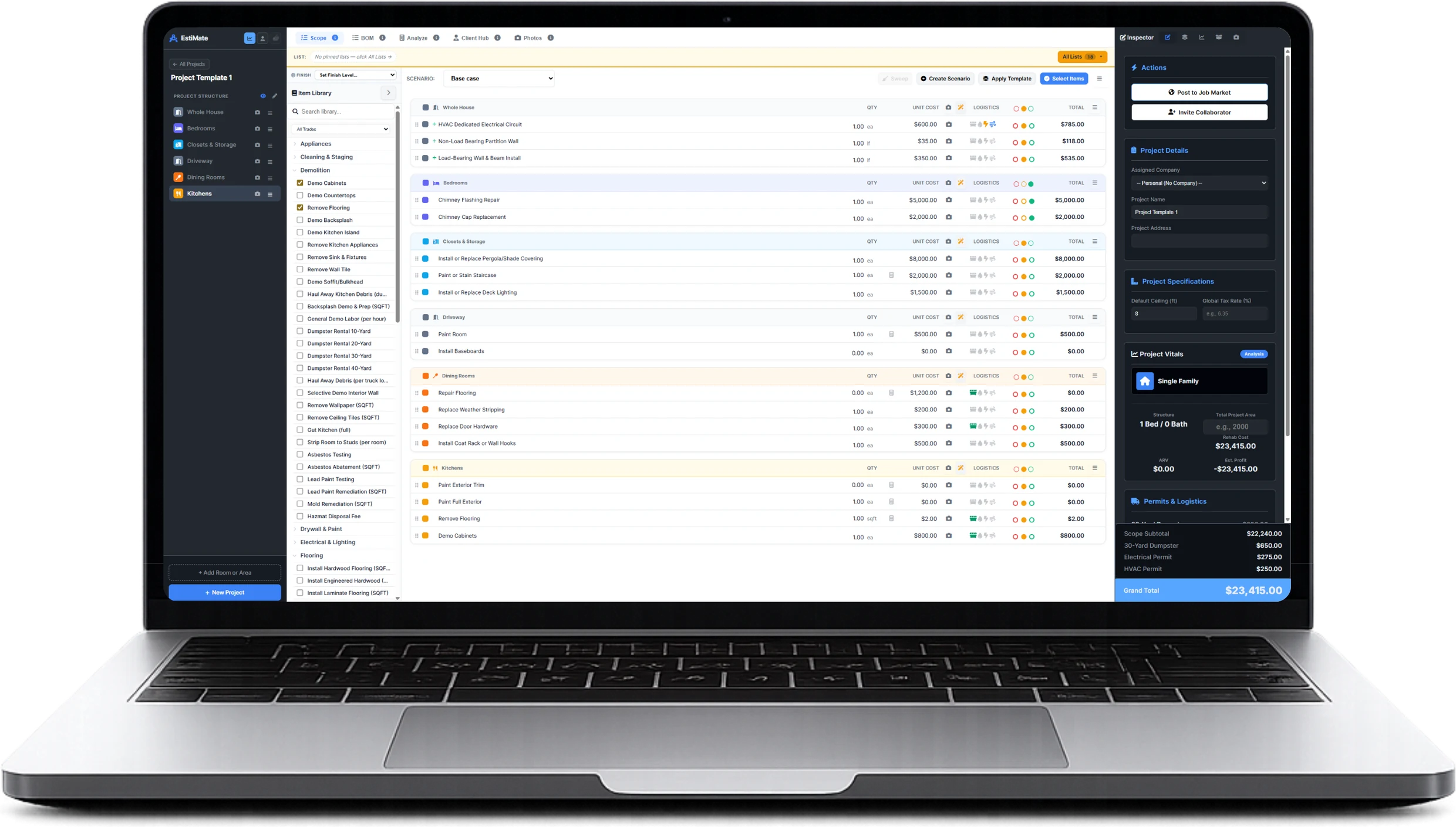
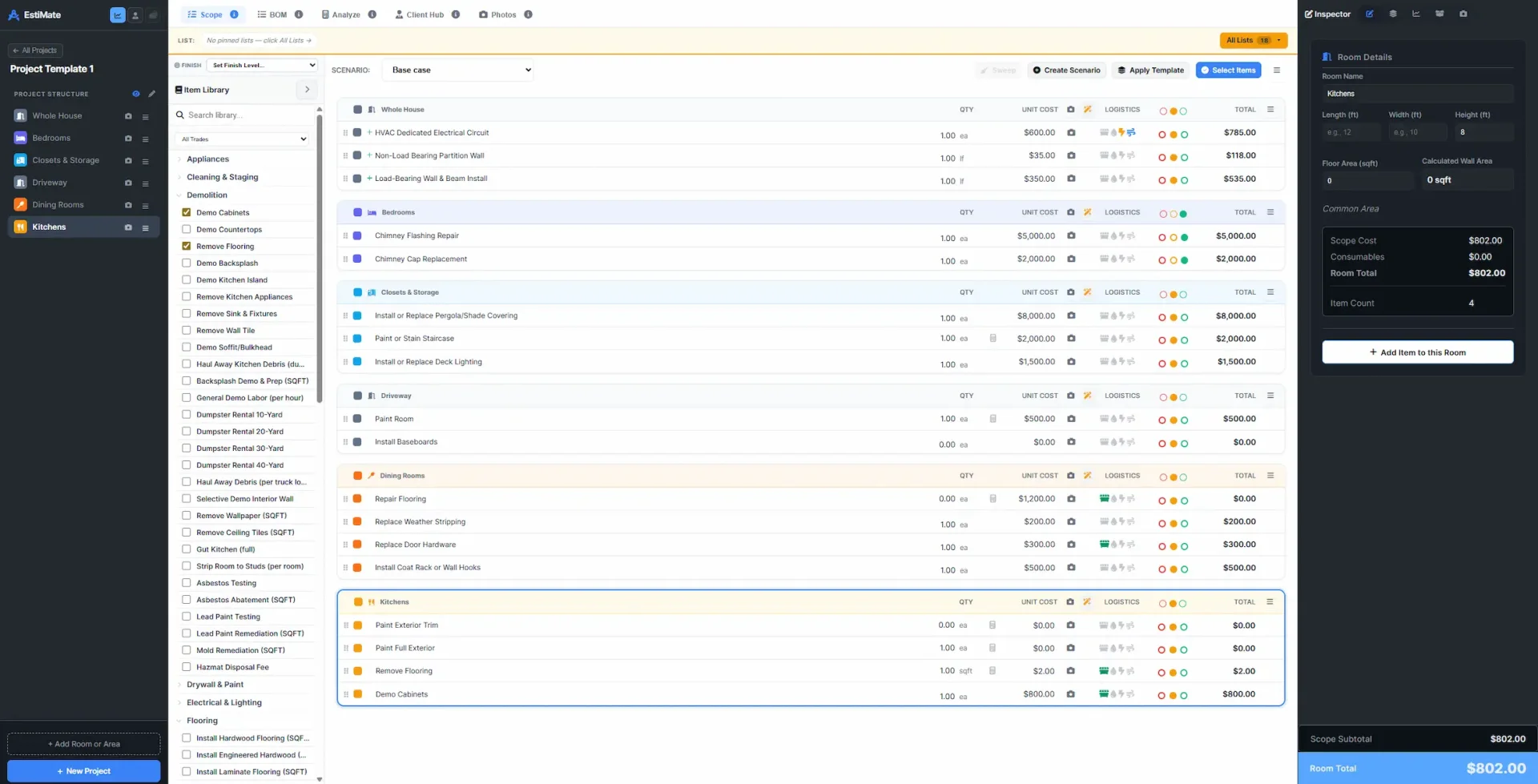
Roof $11,400, kitchen $18,900, two baths $12,800, flooring $7,250, furnace $6,740, paint and the rest $4,000: $61,090, plus 10% contingency = $67,200.
Walk the house before you trust any number.Add buying and loan costs
Closing costs about 1.5% of the price, plus your lender's points and fees. On a $150,000 purchase with a hard money loan: about $5,500.
Add holding costs for every month
Loan interest, taxes, insurance, utilities: about $1,600 a month here. Six months: $9,600. How holding costs eat a flip.
Most flips take longer than planned. Use the realistic number of months, then add one.Add selling costs
Agent commissions, closing costs and seller concessions: about 8% of the sale, here $20,640.
Work out the profit and return
$258,000 − $150,000 − $67,200 − $5,500 − $9,600 − $20,640 = $5,060. That is far too thin: at $150,000 this is not a flip. At $120,000 the profit is about $35,000.
Stress test it
Rerun with ARV 5% lower, repairs 15% higher and two more months. If it still makes money, buy it. How to stress test a deal.
Do it for real, step by step, in the free wholesaling course.
This guide explains how to analyze a fix and flip. The Ethical Wholesaling Course walks you through it as part of your first deal, one lesson and one task a day for 30 days, with Humphrey in every lesson as a mentor who knows where you are. It is completely free, and it does not leave the hard parts to you.
You do not have to buy anything. The course is taught inside Apex Vivus, but you can do every lesson with your own website, your own CRM, your own deal analyzer and your own lead sources.
Start the free course →- Free cash buyersready on day one, by market and buy box
- A free deal marketplaceyour contract goes to every buyer it fits
- Free Calculizersthey do the math and flag what is wrong
- A free communitywholesalers, buyers, lenders and agents
Run your own flip through the numbers.
Profit = ARV − purchase − repairs − buying and loan costs − holding × months − selling costs. Return = profit ÷ cash you put in.
Mistakes to avoid.
Use several adjusted comps, not the top one.
Add about 10% to repairs.
Plan the realistic hold, plus one.
Often 6% to 10% of the sale.
$30,000 on $30,000 of cash is great; on $200,000 it may not be.
Questions, answered.
How do you analyze a fix and flip?
Find the after repair value from adjusted comps, price repairs room by room with a 10% contingency, add buying and loan costs, holding costs for every month and selling costs, subtract them all from the after repair value for your profit, divide by your cash for your return, then stress test with worse numbers.
What is a good profit on a flip?
Many flippers aim for at least 10% to 15% of the after repair value, or $25,000 to $50,000 on a typical house, after every cost. The right number depends on your risk and the time involved.
What costs do people forget in a flip?
Holding costs for extra months, selling costs (often 6% to 10%), loan points and fees, a repair contingency, and utilities and insurance while the house is empty.
The free tools that help, at $0.
Every one of these is free. Use them before you pay for anything.
- The free Ethical Wholesaling Course →The Ethical Wholesaling Course is a free 30-day course that takes you to your first wholesale deal one lesson and one task a day, and comes with free cash buyers, a free deal marketplace, free Calculizers and a free community.
- Calculizer: six strategies at once →Calculizer is a free real estate investment calculator that runs one property as a flip, a rental, a short-term rental, a BRRRR, a wholesale deal and a house hack, side by side.
- Repair Cost Estimator →The Repair Cost Estimator is a free tool that gives a quick rehab budget for a house from its size and condition, before you walk it.
- Wholesale Calculizer →The Wholesale Calculizer is a free wholesale deal calculator: enter the after repair value and the repairs, and it gives your maximum allowable offer and your assignment fee.
- Private money lenders network →The private money lenders network is where investors and private lenders meet around real deal pages with the after repair value, the repair scope and the numbers.
- Wholesaling community →The REILink wholesaling community is a free group of wholesalers, cash buyers, lenders and agents where you ask questions, share deals and learn from people a few deals ahead of you.
Weighing your options? See them side by side.
Honest, scored comparisons of the systems investors move between, the good and the bad of each. And if you would rather ask than read, Humphrey answers out loud.
- Best Carrot alternativesEvery Carrot alternative scored, the good and the bad.
- The Carrot alternativeWhat you get when you move from Carrot, and what it costs.
- Apex Vivus vs CarrotFeature by feature, price by price.
- Best REsimpli alternativesThe CRMs wholesalers move to, scored on one standard.
- The REsimpli alternativeEverything REsimpli does, plus the website and the follow-up.
- Apex Vivus vs REsimpliSide by side, yearly price with yearly price.
- Apex Vivus vs REI BlackBookWhere each one is stronger.
- Apex Vivus vs GoHighLevelBuilt for investors vs built for agencies.
This guide's companions.
- Best real estate deal analysis softwareAnalyzers compared, and the inputs that make a bad deal look good.
- How holding costs affect flip profitWhat each extra month really costs.
- How to stress test a real estate dealWorst, base and best case before you sign.
The other software guides, in plain words.
- Best real estate investing softwareThe whole investor stack, what to look for and how to choose.
- Best rehab estimating softwareEstimating repairs before you make an offer.
- Best real estate wholesaling software13 tools scored, with prices and the laws software must handle.
- Best software for finding cash buyersBuyer lists that buy, compared.
- Best CRM for real estate investorsInvestor CRMs scored on one standard.
- Best motivated seller softwareTools for finding sellers, and why lists alone fail.
- Best real estate offer softwareMaking offers sellers accept and buyers pay.
- MAO calculatorYour maximum allowable offer, with the formula shown.
- Assignment fee calculator (MaxFee)The highest fee your buyers will still pay.
- Best house flipping softwareRunning a flip from offer to sale.
- Best real estate disposition softwareSelling contracts to buyers who close.
- Best real estate investor website buildersEvery builder compared.
- Best real estate comps softwareComps tools compared, and what they miss.
- ARV calculatorAfter repair value from your comps, adjusted.
- Best real estate lead generation softwareWhere seller leads really come from.
- Best real estate follow-up softwareFollow-up that runs without you.
- Best SEO software for real estate investorsRanking for sellers, compared.
- Real estate marketing attribution softwareWhich marketing brought which deal.
- AI software for real estate investorsWhat AI really does today, and what it cannot.
- Property data software for real estate investorsData tools compared, and how fresh their data is.
- Real estate investor contract softwareContracts, e-signature and deadlines.
- Real estate investor lead capture softwareForms that turn visitors into sellers who call.
- Best real estate agent softwareFor agents who work with investors and sellers.
- Best CRM for real estate agentsAgent CRMs compared.
Ready to run every step of the deal in one system?
Find sellers, reach them first, price the repairs, make an offer backed by what cash buyers really pay, sign the contract and get paid, in Apex Vivus, for $97 a month for your whole team. Moving from another system is free.
Hi, I'm 
Want me to walk you through this guide?
Can't hear me? Make sure your speakers are on